
Tesla Wall Connector vs Ocular vs Zappi: which EV charger should you fit in Brisbane?
Honest 2026 comparison: cost, smart features, solar matching, install requirements. The chargers I'd actually fit my own car for, and the ones I wouldn't.
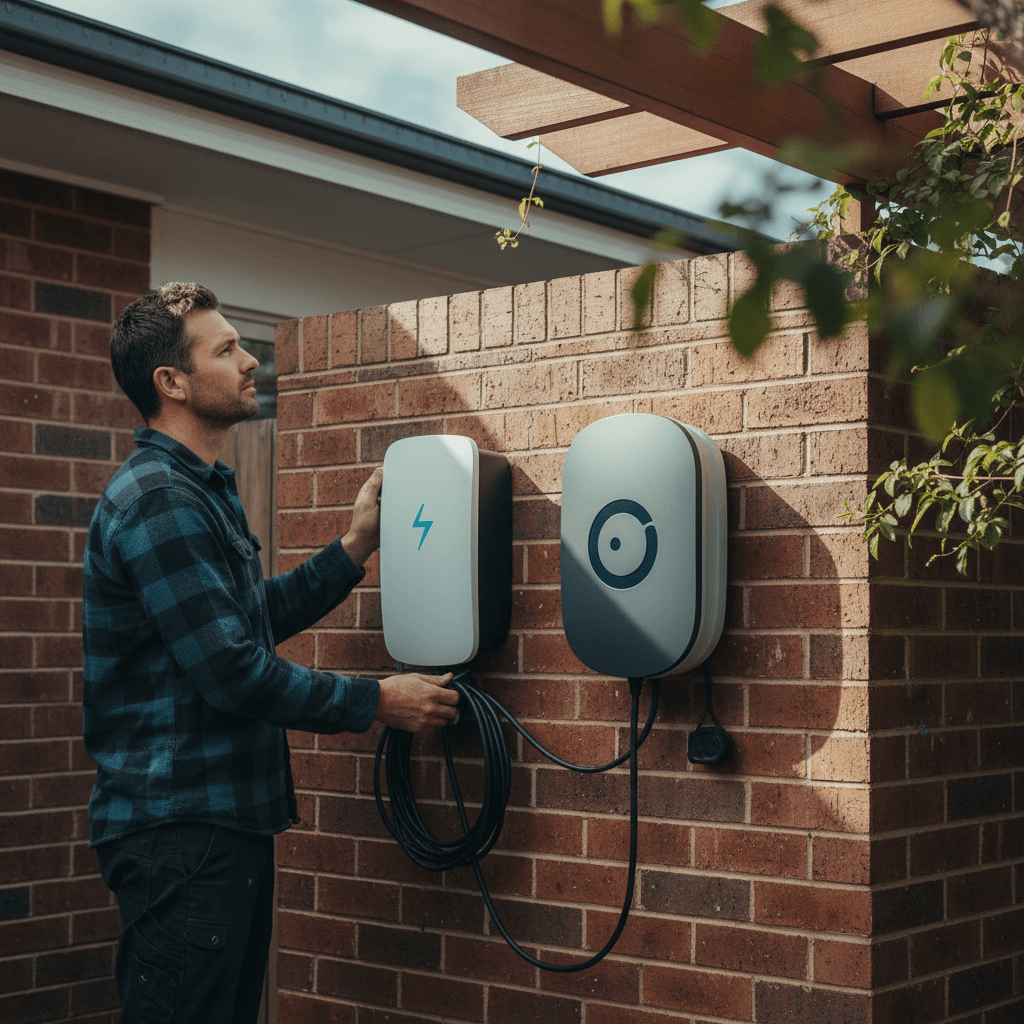
I get asked this comparison question roughly twice a week. Someone's just picked up a new EV, they've found my EV charger install page, and they want to know which wall charger to buy before they ring to book.
The honest answer is: it depends on whether you have solar, whether you care about load management, and whether you drive a Tesla. Here's the breakdown for Brisbane conditions in 2026.
The install baseline across all of these is the same: dedicated 32A circuit, 7.4kW single-phase, 6mm² cable, RCBO at the switchboard. See the full EV charger install cost guide for Brisbane for the electrical scope pricing.
Tesla Wall Connector Gen 3
Hardware cost (2026): Approximately $750-$850.
What it does:
- 32A, 7.4kW, single-phase. Max charge rate for most EVs on single-phase supply.
- Native integration with the Tesla app and Tesla vehicle. If you drive a Tesla, the app shows real-time charging, lets you schedule charging to off-peak tariffs and you can set charge limits from the car's screen.
- Power Sharing: up to four Wall Connectors can share a single circuit through Tesla's proprietary load-sharing protocol. Useful if you have two Teslas.
- Solar matching: None. The Tesla Wall Connector does not have a solar divert function. You can schedule it to run at solar production times (typically 10am-3pm) and that's the extent of solar interaction on the standard firmware. There is a Powerwall-to-Wall Connector integration if you have a Powerwall, but it's limited.
- Open protocol (OCPP): No. Proprietary protocol. Works natively with Teslas; non-Tesla EVs charge at whatever current the vehicle requests.
Best for: Tesla owners who don't have solar, or who have a Powerwall and want simple Tesla-ecosystem integration. Not a good fit if you have a solar system from another inverter brand and want to maximise self-consumption.
Ocular IQ
Hardware cost (2026): Approximately $1,100-$1,350.
What it does:
- 32A, 7.4kW, single-phase. Same peak output as the Tesla.
- OCPP compliant: Works with third-party energy management systems and smart home platforms.
- Dynamic load management: The Ocular IQ can communicate with your switchboard (via a current transformer clamp) to monitor total house load and reduce the charge rate automatically to prevent the main fuse from tripping. Particularly useful in homes where the total connected load (AC, oven, charging) approaches the supply capacity.
- App control: Ocular's iOS/Android app allows scheduling, session history, cost tracking and rate-period configuration.
- Solar divert: Available via the CT clamp reading. Not as sophisticated as the Zappi's algorithm, but it can reduce charge rate during low solar production and ramp up when surplus is available. Works best when paired with a compatible inverter (Sungrow, SolarEdge, some Fronius).
- Type 2 cable: 5-metre tethered cable standard. Compatible with all current EVs (non-Tesla need an adapter for Tesla port vehicles; Tesla Model 3 Highland and later uses Type 2 in Australia).
Best for: Non-Tesla EV owners with solar who want better-than-basic solar matching and load management, without paying Zappi prices. Good fit for Brisbane homes where load diversity (AC + EV simultaneously) is a real concern.
Zappi v2.1
Hardware cost (2026): Approximately $1,350-$1,550.
What it does:
- 32A, 7.4kW, single-phase.
- Solar matching: this is what the Zappi does better than anything else on the market. Three modes:
- Fast: Charges at full 32A regardless of solar production. Standard EVSE behaviour. - Eco: Ensures a minimum charge rate (6A, the minimum the EVSE can supply) and boosts up to full rate based on solar surplus. You always charge, but at the solar-influenced rate. - Eco+: Only charges using surplus solar. The car will not charge at all if there's no surplus. Useful if you want zero grid draw while charging.
- No hub required: The Zappi reads solar surplus directly via a CT clamp (current transformer) on the import/export cable. Works with any inverter brand because it reads the grid current, not the inverter's protocol.
- OCPP: Yes, supported in firmware. Can integrate with third-party energy management.
- myenergi hub: An optional hub ($150-$200) allows integration with the myenergi ecosystem (Eddi hot water diverter, Harvi wireless CT). For whole-home energy management on a budget, myenergi's ecosystem is clever.
Best for: Anyone with solar who wants to maximise self-consumption for EV charging. The Eco/Eco+ modes can meaningfully reduce grid draw for EV charging, particularly in Brisbane where daily solar generation is high and the feed-in tariff is poor (5-6c/kWh vs 30c/kWh import). For the Zappi to pay back its premium over a basic charger, you need to be regularly charging with meaningful solar surplus. That means being home during the day, or a schedule that aligns with peak generation.
Solar divert and matching
To put the solar-matching difference in concrete terms for a Brisbane home:
- A typical home with 6.6kW solar generates 25-32kWh on a clear Brisbane summer day.
- Peak generation (10am-3pm) averages 3-4kW surplus above household load.
- On a Zappi in Eco mode, that 3-4kW surplus charges your EV at roughly 13-17A for 5 hours = 15-20kWh of "free" charging per day.
- At 30c/kWh import rate vs 5c/kWh feed-in rate, that's a 25c/kWh saving on whatever you divert into the car.
- A Tesla Model 3 uses roughly 15kWh per 100km. Diverted solar reduces charging cost from ~$4.50/100km (grid) to near-zero for solar-charged kilometres.
The Zappi earns back its premium over a basic charger in roughly 18-24 months of regular solar-divert charging. The Ocular's solar divert is less precise but still meaningfully better than no solar divert at all.
Full installed cost comparison
Brisbane 2026 pricing for a typical install (32A dedicated circuit, RCBO, 5-8m cable run to garage, no switchboard upgrade needed):
| Charger | Hardware | Install | Total | |---------|----------|---------|-------| | Tesla Wall Connector Gen 3 | $800 | $950-$1,400 | $1,750-$2,200 | | Ocular IQ | $1,200 | $950-$1,500 | $2,150-$2,700 | | Zappi v2.1 | $1,450 | $950-$1,500 | $2,400-$2,950 |
Add $1,650-$2,800 if a switchboard upgrade is required. Add $250-$600 for a consumer mains upgrade if the existing cable is undersized.
Which one I'd fit
My actual recommendation, based on what I see fitting in Brisbane homes:
- You drive a Tesla, no solar or Powerwall: Tesla Wall Connector. Ecosystem integration is genuinely good, hardware is reliable, price is competitive.
- You drive a non-Tesla, no solar: Ocular IQ. Better app, load management, open protocol. Worth the extra $300-$400 over a generic EVSE.
- You have solar (any brand), any EV: Zappi v2.1. The solar divert pays for itself if you charge regularly during the day. Eco+ mode is genuinely useful in Brisbane. Set it and forget it.
- You drive a Tesla AND have solar and Powerwall: The Tesla ecosystem (Powerwall + Wall Connector + Tesla Energy app) handles solar self-consumption reasonably well now with the Powerwall 3. If you want the cleanest single-app experience and you're already in the Tesla ecosystem, stay there.
If you're in Carindale, Camp Hill or Wakerley and you want an EV charger installed, give me a call on 0411 054 811. I can advise on the right charger for your car and solar setup, quote the full electrical scope, and get it done in a single visit.
, John
I'm John, local Camp Hill sparky, fully licensed, fixed-price quotes, lifetime workmanship warranty. Ring me direct on 0411 054 811 or send a quick message.
Keep reading
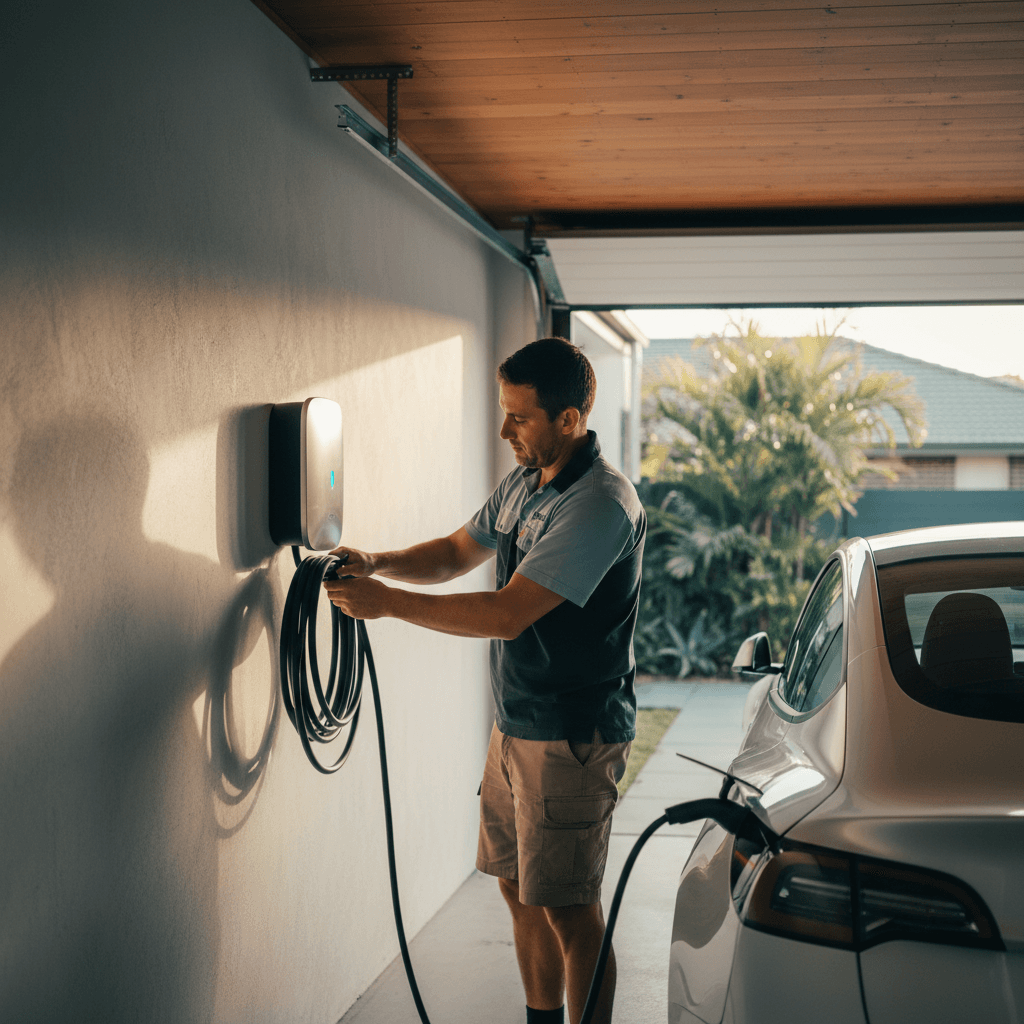
Home EV charger install in Brisbane: cost, process and the things nobody warns you about
What you'll actually pay for a 7kW or 22kW EV charger install at home in Brisbane, the load assessment process, and the four gotchas that bump the price.
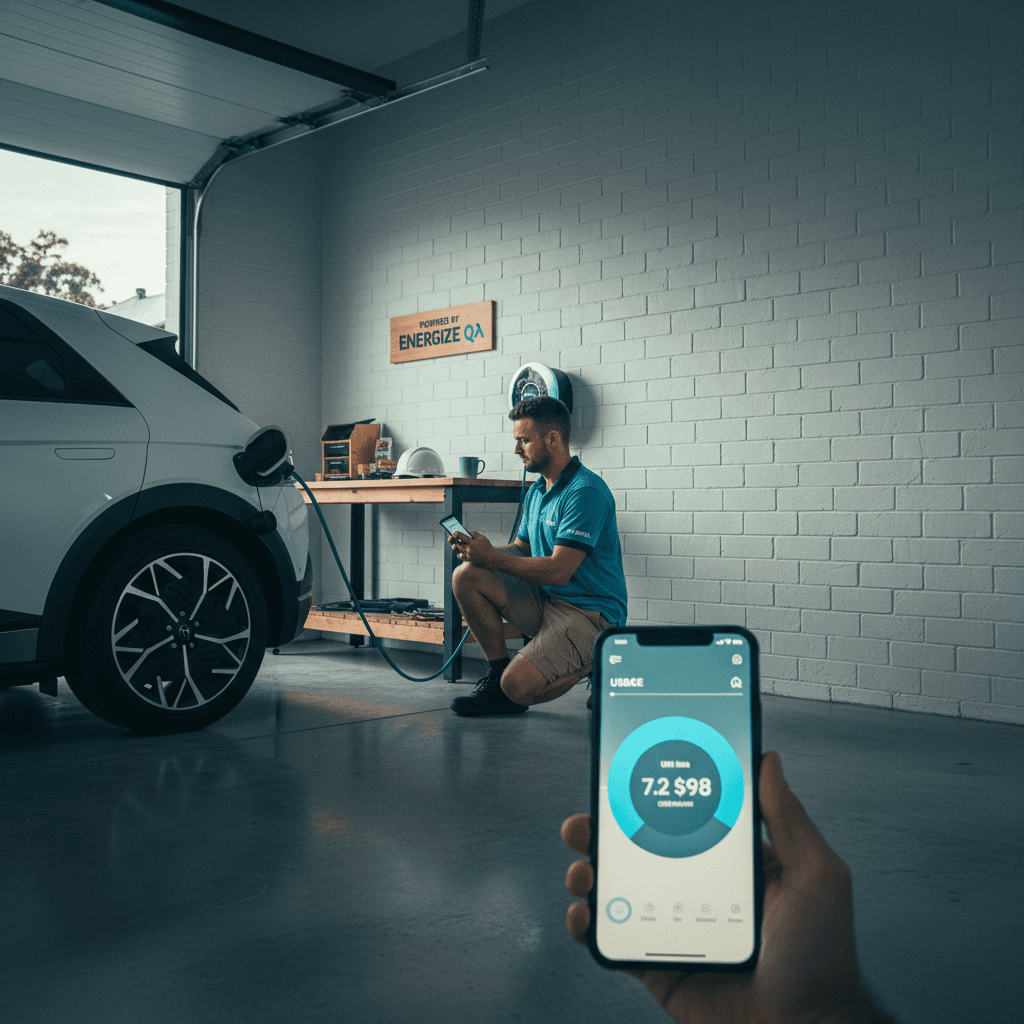
How much does it cost to charge an EV at home in Queensland? (Real 2026 numbers)
Tariff 11, Tariff 33, solar self-consumption, public chargers: the real cost per km of charging your EV at home in Brisbane in 2026.