
Home solar battery installation cost in Brisbane (2026): the real numbers
Tesla Powerwall 3, Sungrow, BYD: what a battery actually costs installed in 2026 Brisbane, what the rebates pay back, and the real payback period.
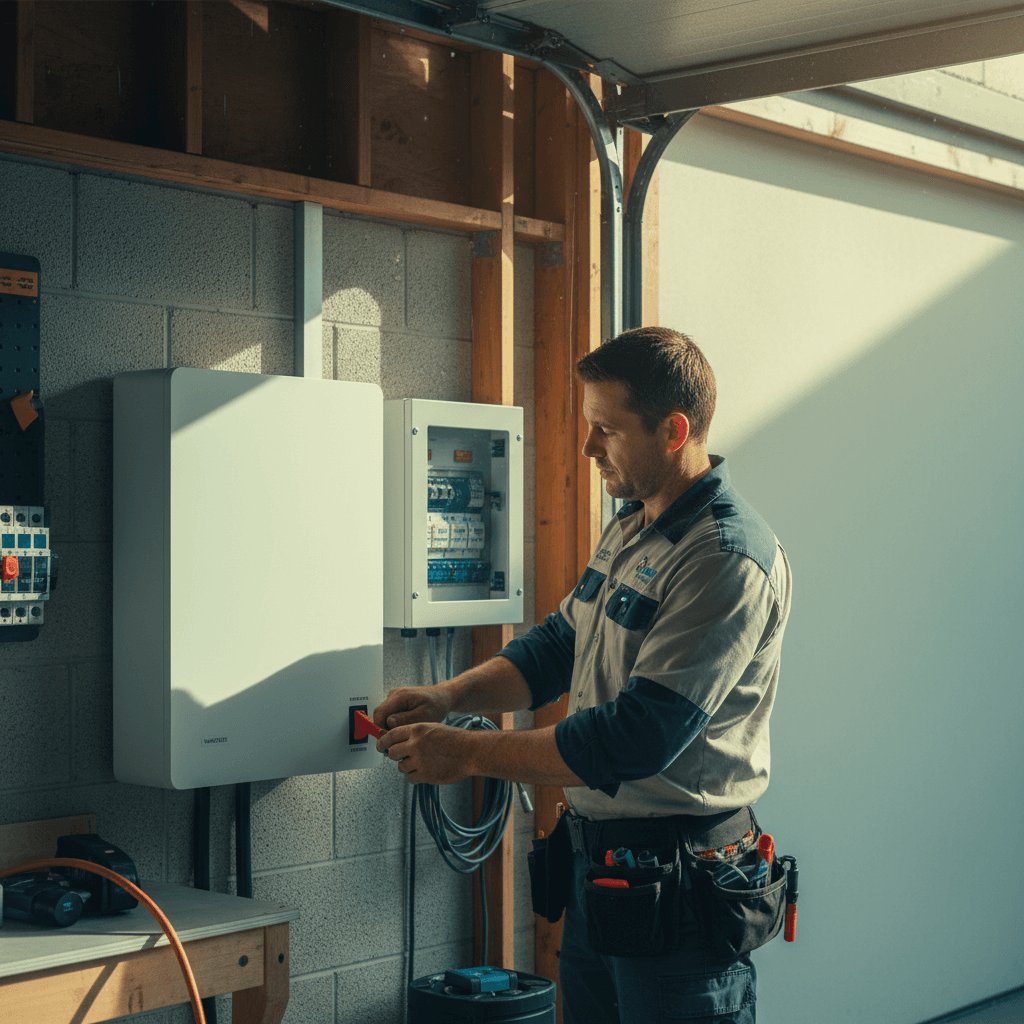
Home battery storage is the topic I get the most questions about from homeowners in Carindale, Wakerley and Mansfield who already have solar. They've heard the prices are coming down, they've seen the Federal rebate announced, and they want to know if the numbers actually work.
Here's the honest picture as of mid-2026, from someone who does the electrical side of these installs and has no stake in which brand you buy.
What batteries actually cost installed in 2026
These are supply-and-install prices including all electrical work, a compliant switchboard connection and system commissioning, but excluding any switchboard upgrade if one is required.
Tesla Powerwall 3 (13.5kWh):
- Hardware: approximately $12,000-$13,500 from an authorised installer.
- Install: $1,500-$2,500 depending on cable run and switchboard configuration.
- Total installed: $13,500-$16,000.
- The Powerwall 3 includes an integrated inverter, which simplifies the install for new solar systems but requires specific configuration with existing solar inverters.
Sungrow SBR (9.6kWh, modular):
- Hardware: approximately $8,500-$10,000.
- Install: $1,200-$2,000.
- Total installed: $9,700-$12,000.
- Sungrow makes solid inverters and batteries. The modular design (up to 25.6kWh in a stack) is useful if you want to expand.
BYD Battery-Box Premium HVS (10.2kWh):
- Hardware: approximately $9,500-$11,500.
- Install: $1,200-$2,200.
- Total installed: $10,700-$13,700.
- BYD uses lithium iron phosphate (LFP) chemistry, which is more thermally stable than NMC, relevant for hot Brisbane summers.
Alpha ESS Storion (10.1kWh):
- Hardware: approximately $7,500-$9,500.
- Install: $1,000-$1,800.
- Total installed: $8,500-$11,300.
- Alpha ESS has improved significantly in the Australian market. Less-known brand, lower upfront cost, 10-year warranty on most models.
These prices move around. Get three quotes, make sure they include identical scope (commissioning, protection settings, grid connection notification to Energex).
Rebates and incentives available in QLD
Federal Cheaper Home Batteries Program (from 1 July 2025): The Federal Government introduced this as part of the 2025-26 budget. It provides a means-tested rebate that effectively reduces the GST and associated cost on eligible battery systems. The program targets systems installed by accredited installers (CEC accredited). In practice, the reduction for a mid-sized system is in the order of $3,500-$4,500 depending on system size. Check current eligibility via the government's energy.gov.au website, as the scheme details evolve. I'd encourage anyone getting quotes now to confirm with the installer that the rebate is being applied and how.
Small-scale Technology Certificates (STCs): Solar panels attract STCs. Batteries on their own do not attract STCs, but if you're adding a battery at the same time as a new solar system, the combined system can generate STCs on the solar component, reducing the overall system cost by $800-$2,000 depending on system size.
Feed-in tariff opportunity cost: Not a rebate, but worth including in the calc. SE QLD feed-in tariffs are currently around 5-6c/kWh under Energex's standing offer. Every kWh you self-consume instead of export is worth the difference between your import tariff (roughly 30c/kWh) and the feed-in rate, so approximately 24-25c of value per kWh that you divert from export to self-consumption. A 10kWh battery that displaces export solar into evening consumption can save $600-$900 per year in energy bills, depending on your consumption patterns.
Realistic payback period
At current Brisbane energy prices and with the Federal rebate applied, payback on a mid-sized home battery is roughly:
- Powerwall 3 (after $4,000 rebate): 9-12 years.
- Sungrow or BYD 10kWh (after $3,500 rebate): 7-10 years.
- Alpha ESS or similar budget option (after rebate): 6-9 years.
These are back-of-envelope based on: 10kWh usable capacity, 250 effective cycles per year, 24-25c per kWh value per cycle, and no grid export during battery discharge. Real payback depends heavily on your consumption profile. If you use a lot of power in the evening (aircon, cooking, EV charging), batteries return value faster. If most of your consumption is during the day when you're already self-consuming solar, the battery adds less value.
I'd be sceptical of any installer who gives you a payback period under 6 years without a detailed energy audit of your usage patterns.
How to size a battery for a Brisbane home
A useful rule of thumb: size the battery to cover your evening and overnight consumption, minus any overnight generation (which for solar is zero). For most Brisbane families:
- Evening load (5pm-11pm): 8-15kWh
- Overnight (11pm-6am, fridge, alarms, standby): 2-4kWh
- Total: 10-19kWh per night
A 10kWh battery covers most of the evening load and offsets morning grid draw. A 13-15kWh battery (Powerwall 3) covers the full evening and overnight for average families.
Don't over-size. A 20kWh battery in a house that only exports 8kWh of surplus solar per day will never charge fully, and you're paying for capacity you can't fill. Your installer should show you a load profile analysis from your smart meter data before recommending a size.
What the switchboard needs
This is the part no one mentions in the battery quote until you've already signed.
A home battery install typically requires:
- Dedicated circuit from the switchboard to the battery location. Usually 16A or 32A depending on the inverter-charger spec.
- Backup/critical loads sub-board (if you want blackout protection). This is a separate small board wired through the battery, containing only the circuits you want powered during a blackout (fridge, some lights, a GPO, the modem). This adds $600-$1,200 to the electrical scope.
- Anti-islanding settings on the inverter, configured correctly and notified to Energex. This is the installer's job but confirm it's done.
- Switchboard upgrade if your existing board has no spare positions or is pre-2000 vintage. Add $1,650-$2,800.
What I'd recommend
For a typical Brisbane family of 3-4 with a 6.6kW solar system:
- Battery: BYD or Sungrow 10kWh. LFP chemistry handles Brisbane heat better than NMC. Modular if you might expand.
- With blackout protection: Add the critical-loads sub-board. For Brisbane, where storms knock the grid out 2-3 times a year, it's worth the extra $800.
- Without blackout protection: Any battery will still save you money on self-consumption during normal operation; you just won't have power if Energex is out.
The Powerwall 3 is a fine product but carries a premium for the Tesla brand and the integrated inverter. If your existing solar inverter is Sungrow or Fronius, the same-brand battery often has simpler integration.
For a complete solar battery quote including all electrical work, ring 0411 054 811. I work with most of the accredited installers in SE QLD and can coordinate the full scope from switchboard to commissioning.
, John
I'm John, local Camp Hill sparky, fully licensed, fixed-price quotes, lifetime workmanship warranty. Ring me direct on 0411 054 811 or send a quick message.
Keep reading
Solar inverter compliance in QLD: the rules that catch homeowners out
Anti-islanding, export limits, isolators, labelling, and the SAM application: what your solar install needs to legally feed back to the grid in 2026.
How much does it cost to rewire a Brisbane house in 2026? Full breakdown
Full rewires range $8,500 to $25,000+ in Brisbane in 2026. Here's what drives the price, what's included in a real quote, and three real jobs.