
Solar inverter compliance in QLD: the rules that catch homeowners out
Anti-islanding, export limits, isolators, labelling, and the SAM application: what your solar install needs to legally feed back to the grid in 2026.
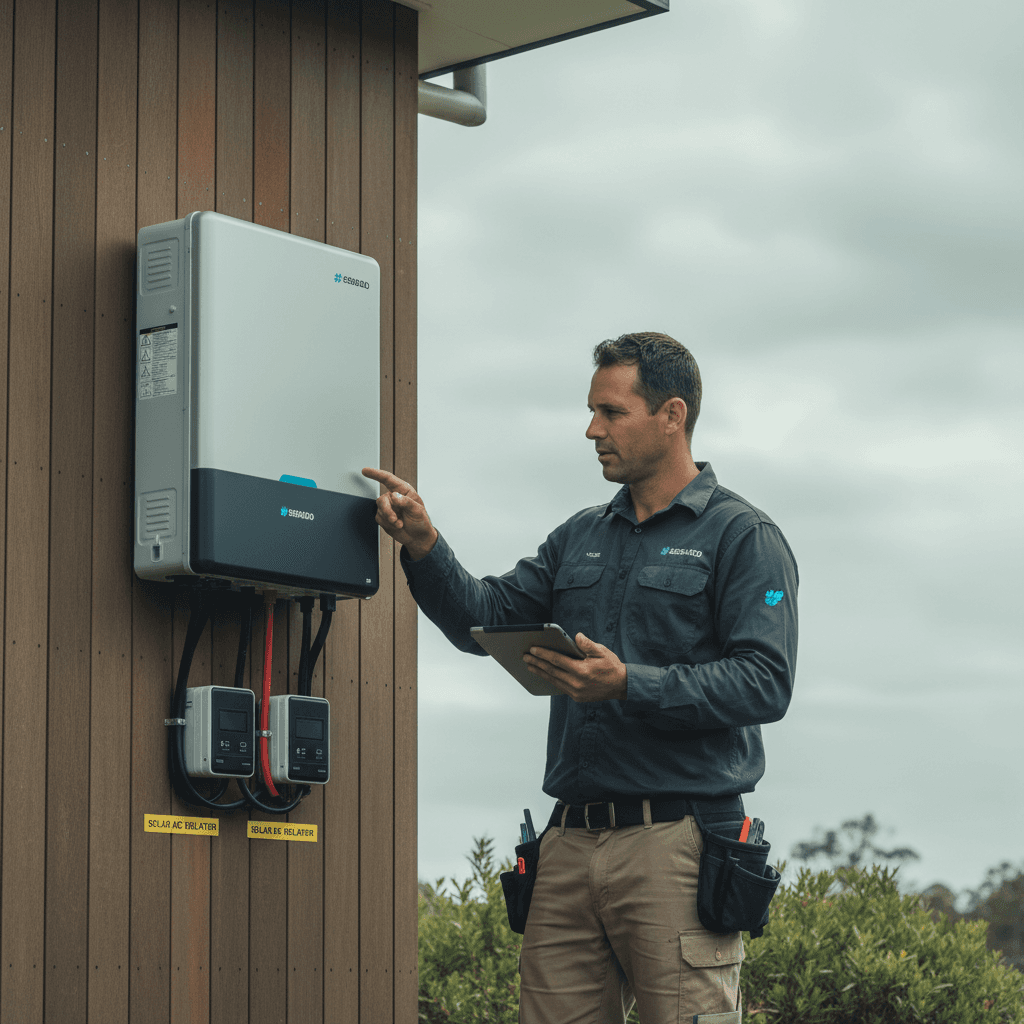
Most homeowners think solar compliance means getting a system installed and turning it on. Nobody tells you there's a stack of electrical and network requirements that must be met before your system legally exports power to the Energex grid. Miss any of them and you're either non-compliant, uncertified, or quietly selling power you're not permitted to sell.
Here's what the rules actually require, in plain English, from someone who does solar-adjacent electrical work regularly across Carindale, Wakerley, and Mansfield.
The standards that apply
Two Australian standards govern residential solar:
- AS/NZS 5033 covers the PV array itself: string sizing, cable, fusing, DC isolators, connectors, earthing of the array frame.
- AS/NZS 4777.2 covers the inverter: how it connects to the grid, anti-islanding protection, voltage and frequency ride-through, and the communication interface Energex uses to control export.
Both are referenced by the Electrical Safety Regulation 2013 (QLD) and are mandatory, not optional best-practice. Your installer must be a Clean Energy Council (CEC) accredited installer to sign off a grid-connected system. The Certificate of Test (Form 16) issued at the end covers the electrical installation; the CEC accreditation covers the design.
Isolators: AC and DC
This is where I've seen the most corner-cutting on systems installed by whoever won the lowest tender.
DC isolator at the array: There must be a DC isolator at the solar array (roof-level) or as close as practicable. Its job is to let a firefighter or electrician kill the DC side without going near the switchboard. The isolator must be rated for DC duty (AC-rated isolators fail at DC), labelled correctly, and accessible. It's a solar PV DC isolator, not a repurposed light switch.
AC isolator at the inverter: There must also be an AC isolator adjacent to the inverter, within sight of it, so the inverter can be isolated from the grid without disconnecting power to the whole house. Typically this is a mains-rated double-pole switch mounted right next to the inverter enclosure.
Both isolators must be weatherproof if they're exposed to the elements, which on a Brisbane exterior wall in SE QLD conditions they almost always are.
Labelling requirements
This is another area that gets skipped. The wiring rules and AS/NZS 5033 between them require:
- A label at the main switchboard identifying the solar system and which circuit breaker feeds it.
- A warning label at the inverter AC isolator: "WARNING: ISOLATE SOLAR SUPPLY BEFORE WORKING ON AC WIRING."
- A label on the DC isolator at the array.
- A label at the switchboard consumer mains or meter box warning that this property has a solar system and that the wiring may be energised even when the main switch is off. This is the one firefighters need.
- The inverter itself must carry a CEC compliance plate confirming it meets AS/NZS 4777.2.
Labels must be durable, UV-stable, machine-printed or engraved. A hand-scrawled sticky label does not meet the standard. I've pulled the covers off meter boxes on properties in Carindale and Mansfield where the only labelling was a felt-tip scrawl from 2012. That's not compliant.
Export limits and the SAM application
If you want to export power to the Energex network, you need a Small-scale Technology Certificate (STC) system registered with Energex through the Solar Application Management (SAM) portal. The network does not accept unregistered generators.
Energex imposes export limits based on the capacity of the local network. In most of SE QLD's inner suburbs, the default limit for a single-phase connection is 5kW of export. In some areas it's less. In a few newer areas with upgraded infrastructure, you can negotiate more.
If your system is larger than your export limit, the inverter must be configured to cap export at the permitted level. Modern inverters do this via software settings, but it must be configured correctly and documented. Installing a 10kW inverter on a 5kW export limit and hoping nobody notices is a compliance failure.
Your installer should lodge the SAM application and provide you with confirmation of the approved export limit. If they haven't done that, ask for it before you switch on.
CEC listing and approved inverters
The inverter you install must appear on the Clean Energy Council's approved inverter list. This is not just a quality tick: it's a compliance requirement. An inverter that isn't on the CEC list cannot legally be grid-connected in Australia.
The list is reviewed regularly, and models do get delisted when they fail ongoing testing. If you bought a system several years ago with an inverter that was compliant at the time, it's worth checking it's still on the current list. If it's been delisted, you're in a grey area that your insurer may use against you in a claim.
Look for the CEC approved product sticker on the inverter, confirm the model on the CEC website, and keep a record. Your electrician should document this in the Certificate of Test.
Anti-islanding is the function that comes with CEC listing. It means the inverter automatically disconnects from the grid if the grid goes down, preventing your system from energising a dead line that a linesman might be working on. AS/NZS 4777.2 mandates it, CEC listing confirms it's been tested.
What solar usually means for your switchboard
A lot of solar installs I see on older Brisbane homes trigger a switchboard upgrade that the homeowner wasn't expecting.
Here's why:
- The solar feed-in circuit needs a dedicated circuit breaker in the switchboard, usually at the opposite busbar end to the main switch (a "top of board" connection as required by the wiring rules for generator/grid-interactive circuits).
- A Type 2 surge protection device (SPD) is now strongly recommended, and some installers include it as standard. If your board has no room, you're stuck.
- Older boards with ceramic fuses have no RCD coverage and no space for a solar breaker. They need to go before a solar system can be connected.
- If you're also adding a battery later, you need additional space for the battery isolator and any dedicated battery circuits.
A switchboard upgrade at the same time as a solar install is the most cost-effective sequence. Doing the switchboard separately 18 months later, after the solar is in, costs more in time and access.
If you've got a solar system and you're not sure it was installed correctly, or you're buying a property in Wakerley or Mansfield that already has panels, ring me on 0411 054 811 and I'll do an electrical compliance check on the existing install.
, John
I'm John, local Camp Hill sparky, fully licensed, fixed-price quotes, lifetime workmanship warranty. Ring me direct on 0411 054 811 or send a quick message.
Keep reading
Renovation electrical checklist for Brisbane homes (the one your builder won't give you)
What to think about *before* the walls go back up. The 12-point electrical checklist for Brisbane renovations, from powerpoint locations to data cabling.
How much does a switchboard upgrade cost in Brisbane in 2026?
What you'll actually pay for a residential switchboard upgrade in Brisbane in 2026, line by line, plus the four things that move the price up or down.