
Smart smoke alarms vs 240V interconnected: what QLD law says (and what I'd fit)
Google Nest Protect, X-Sense smart alarms: do they meet QLD's 2027 photoelectric interconnected hardwired law? The honest legal answer.
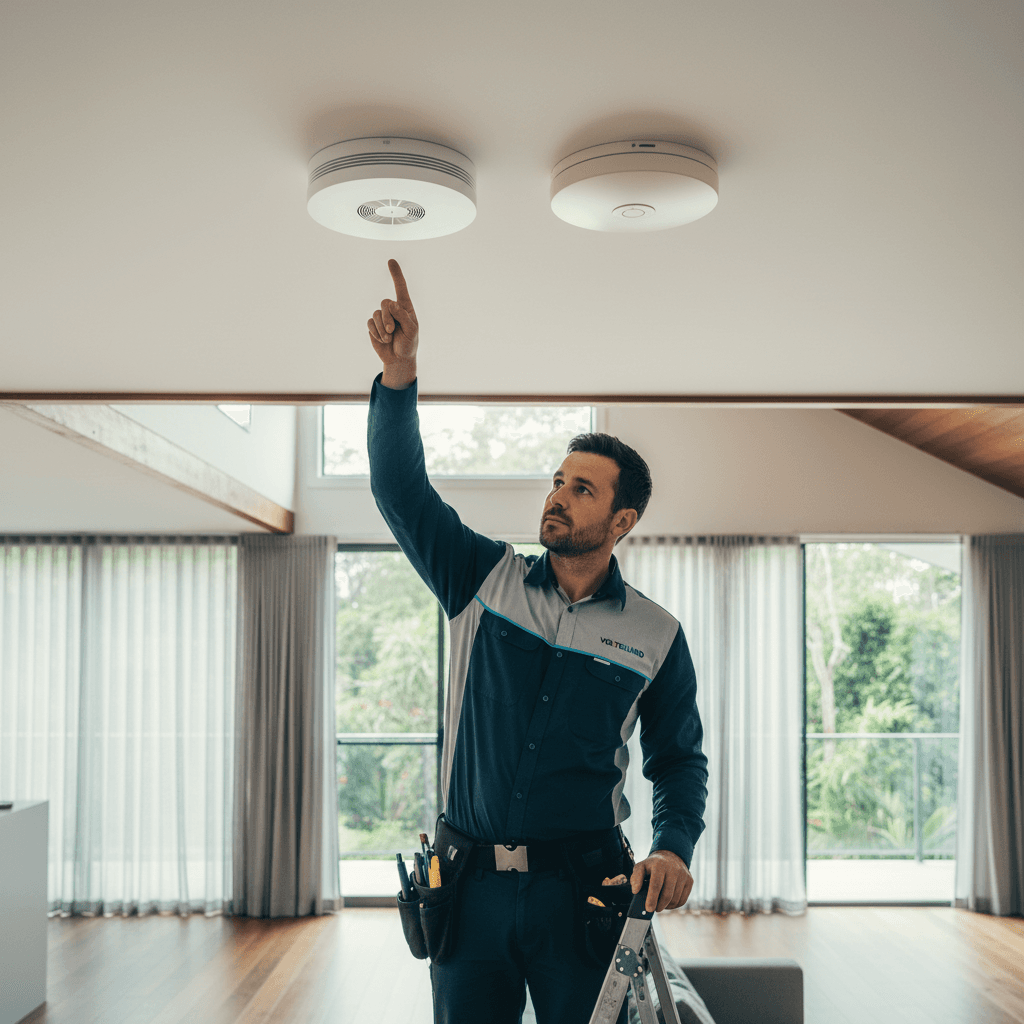
Every second month someone asks me whether the smart smoke alarms they saw on YouTube will satisfy QLD's new laws. It's a fair question. The marketing from brands like Google Nest and X-Sense is compelling, the products are genuinely good, and the compliance answer is "it depends on the specific model and how it's installed." Let me give you the unambiguous version.
The short answer: some smart alarms do comply with QLD law. Others, including some popular battery-only WiFi alarms, do not. Buying the wrong one means you will still be non-compliant on 1 January 2027, and you'll be paying to replace them.
What QLD law actually requires
The QLD smoke alarm laws require that from 1 January 2027, every dwelling must have smoke alarms that are:
- Photoelectric - not ionisation, not combination dual-sensor unless the unit is classified and approved as photoelectric-type under AS 3786:2014.
- Interconnected - when any alarm triggers, all alarms in the home sound simultaneously. The interconnection can be wired (hardwired cable link) or wireless (radio frequency, built into the alarm).
- Hardwired to 240V, OR powered by a non-removable 10-year lithium battery - a replaceable battery, including the standard 9V you used to use, is not compliant.
- Listed to AS 3786:2014 - this is the Australian standard. The alarm must be certified to this standard, which covers detection performance, sound output, and construction requirements.
For dwellings being sold or leased, this has been mandatory since 1 January 2022. For all other homes, the deadline is 1 January 2027.
Two pieces of legislation govern this: the QLD Fire and Emergency Services Act 1990 and the Building Fire Safety Regulation 2008 set the alarm requirements; the Electrical Safety Act 2002 (QLD) governs who installs the hardwired version.
Google Nest Protect: does it comply?
The Nest Protect (2nd generation, Australian model) is a photoelectric + CO detector. The Australian version is listed to AS 3786:2014. Tick.
It interconnects wirelessly using Nest's own RF protocol. Tick.
The critical question is the power source. The battery version of the Nest Protect uses 6 AA alkaline batteries, which are user-replaceable. That is not a non-removable 10-year lithium battery. This model does not meet the "hardwired or 10-year non-removable lithium" requirement for QLD.
There is a wired (240V) version of the Nest Protect. It connects to 240V and has a battery backup. This version, hardwired to mains, with RF wireless interconnect to other Nest Protects in the home: that arrangement does comply with QLD law.
So: Nest Protect wired, multiple units, wireless interconnected = compliant. Nest Protect battery version = not compliant for QLD.
One practical caveat: the Nest Protect wired version must be installed by a licensed electrician because it connects to fixed 240V wiring. Same as any hardwired alarm.
X-Sense smart alarms: does it comply?
X-Sense makes a range of smart smoke alarms, some of which have WiFi app connectivity and some of which have wireless interconnect. The AS 3786:2014 compliance varies by model and needs to be verified on the specific product listing.
X-Sense's SC08 and similar models use a sealed 10-year lithium battery and include wireless RF interconnect. Where those models carry an AS 3786:2014 listing (check the product data sheet and the compliance mark on the unit), they meet the QLD power and interconnect requirements.
The WiFi-only models that connect to an app but do not have RF interconnect between units are a problem. They may alert your phone when triggered, but if one alarm fires and the others do not sound in the home, that is not interconnection in the sense QLD law requires.
Read the product data sheet carefully. "Smart" does not automatically mean "compliant."
What passes the QLD test
An alarm passes if it meets all four requirements simultaneously:
- Photoelectric detection (AS 3786:2014 approved type)
- RF wireless interconnect OR hardwired interconnect between all alarms
- 240V hardwired OR sealed non-removable 10-year lithium battery
- AS 3786:2014 listed (the certification number must appear on the unit and in the documentation)
Products that tick all four: Brooks 600MRF (10-year lithium, RF, AS 3786), Emerald Planet RF range, Nest Protect wired (hardwired, RF, AS 3786), certain X-Sense models with sealed batteries and RF. This is not an exhaustive list; new models enter the market regularly.
What definitely does not pass
- Any replaceable 9V or AA battery alarm, regardless of brand or how smart it is. The battery specification disqualifies it.
- WiFi-only smart alarms that send phone notifications but do not have RF or hardwired interconnect with other alarms in the home.
- Ionisation alarms - banned for new installations in QLD regardless of power source.
- Any alarm not listed to AS 3786:2014. No certification = no compliance. Some imports carry fake marks or marks from other standards that are not equivalent.
- Combination alarms not approved as photoelectric-type under the standard. Some older dual-sensor units do not qualify.
What I actually install and why
My standard fit is the Brooks 600MRF system. Photoelectric, 10-year sealed lithium, RF wireless interconnect, AS 3786:2014 listed, Australian brand. Reliable, good signal penetration through typical Queensland timber-frame construction, and the 10-year lithium means the alarm goes to the bin and gets replaced as a unit rather than the battery-replacement cycle that causes so many failures.
For clients who want app connectivity and the smart features (self-test alerts, monthly test notifications, fault reporting to phone), I'll discuss the Nest Protect wired system. It's more expensive to install (requires hardwiring to each alarm location, $150-$250 per point on top of hardware), but it works and it's compliant.
What I won't install: cheap battery-only alarms from Bunnings regardless of what the box says. The AS 3786 listing needs to be current, the model needs to be registered, and I need to be confident in the interconnect reliability before I put my name on the job.
For a typical 3-bedroom Brisbane home, a compliant smoke alarm installation using Brooks 600MRF runs around $1,100-$1,350 fitted, hardware and labour. It's a 10-year solution, done in 90 minutes.
A few things worth knowing before you go shopping:
Can I mix brands? Wireless RF interconnect is proprietary to each brand. Brooks 600MRF alarms interconnect with other Brooks 600MRF units, not with Emerald Planet units. If you want wireless interconnect to work across all alarms, they all need to be the same brand and the same compatible series. Wired interconnect is standardised (a simple signalling wire between hardwired alarm units), so in a wired system, different AS 3786 compliant brands can coexist.
Does the Nest Protect work with other Nest cameras and displays? Yes, it integrates with the Google Home ecosystem and can send notifications to Nest Hub displays. This is genuinely useful if you want to see which alarm triggered from your phone or a home display. It doesn't change the compliance question - the alarm still needs to be the hardwired (240V) version to meet QLD law.
What about CO (carbon monoxide) detection? QLD law does not currently require CO detection in residential dwellings. The Nest Protect includes CO detection as a bonus feature. This is useful in homes with gas appliances (gas cooktop, gas hot water, gas heater) but is not a legal requirement. If you want CO detection, the Nest Protect wired version is the only AS 3786 product I'm aware of that bundles both in a QLD-compliant package.
When is the 2027 deadline enforced? From 1 January 2027, every dwelling in QLD must comply regardless of whether it is being sold, leased, or simply occupied. Before then (as of 2026), the requirement applies to homes being sold or leased. So if you are currently in a home with no plans to sell or rent, you have until 1 January 2027. But do it now - installers will be fully booked in late 2026 as the deadline approaches.
If you're unsure whether your existing smart alarms are compliant, ring me on 0411 054 811. I can check the model, verify the certification, and tell you straight whether you're covered or not.
, John
I'm John, local Camp Hill sparky, fully licensed, fixed-price quotes, lifetime workmanship warranty. Ring me direct on 0411 054 811 or send a quick message.
Keep reading
QLD smoke alarm laws 2027: the simple version (and what it'll cost)
From 1 January 2027, every QLD home needs interconnected, photoelectric, hard-wired smoke alarms. Here's exactly what you need, where, and what it should cost.
Interconnected photoelectric smoke alarms: a complete guide for Brisbane homes
What they are, how they're different to old ionisation alarms, what brands actually work, and how the wireless interconnect works in practice.