
Interconnected photoelectric smoke alarms: a complete guide for Brisbane homes
What they are, how they're different to old ionisation alarms, what brands actually work, and how the wireless interconnect works in practice.
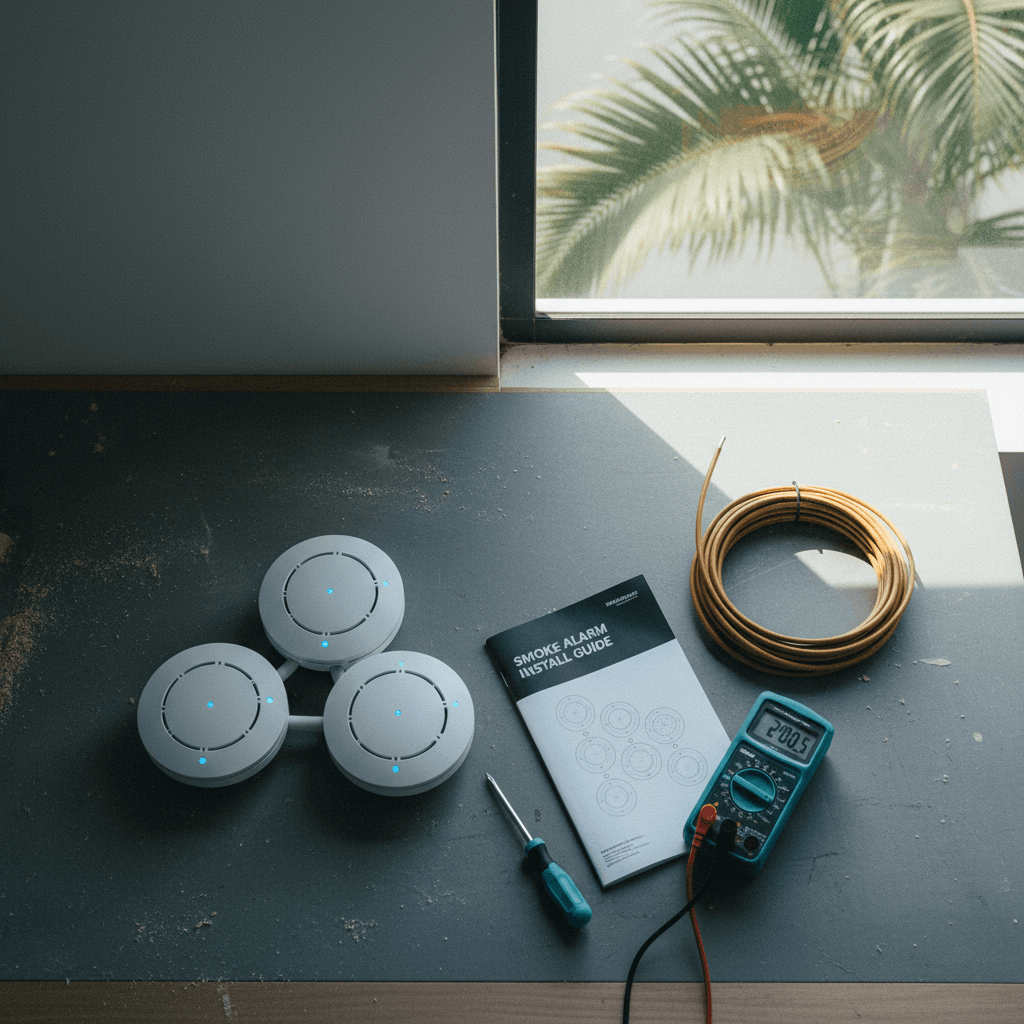
If you've only ever known the cheap white round battery-powered smoke alarms, this is going to feel like a leap. Here's how the modern QLD-compliant gear actually works.
What 'photoelectric' actually means
Smoke alarms come in two main detection technologies:
- Ionisation, uses a small radioactive source to detect ions in the air, disrupted by smoke. Fast at flaming fires (e.g. a match), slow at smouldering fires (e.g. a couch on fire). Cheap, common, no longer compliant in QLD.
- Photoelectric, uses a small light beam and a sensor inside the alarm. When smoke enters the chamber it scatters the light into the sensor. Excellent at smouldering fires, which is the kind that kills sleeping people. Slightly more expensive. This is the type required by QLD law.
In practice, photoelectric alarms catch more real-world house fires earlier. That's why QLD made them the standard.
How wireless interconnect works
Modern alarms (Brooks 600MRF, Emerald Planet, Red Smoke RF) have a small radio inside them. When you install them, you put them all into "learn" mode, and they pair with each other.
When any alarm in the network detects smoke, it triggers all the others in the network to sound at the same time. So if smoke is detected in the back bedroom at 2am, the master bedroom alarm is also screaming, the kids' bedroom alarms are also screaming, and the kitchen alarm is also screaming.
That's the difference between waking up across the house and never waking up at all.
Brands we install (and why)
We install one of two systems on every job:
- Brooks 600MRF. Australian-favourite, 10-year sealed lithium, robust radio, very reliable. About $130 per alarm wholesale.
- Emerald Planet RF interconnected, slightly newer, slightly more app-integrated, slightly nicer to look at. About $115 per alarm wholesale.
We don't install Bunnings-grade alarms. They are not actually cheaper once you factor in failure rate, and they don't carry the QLD compliance approvals reliably enough.
Can you DIY?
Hard-wired alarms must be installed by a licensed electrician in QLD. Replacement of like-for-like 9V battery-only alarms can be DIY (though we'd argue you shouldn't, once you have one hard-wired interconnected alarm in the house, all of them need to be hard-wired interconnected for it to work).
The right play is: book a smoke alarm install, do the whole house in one visit. It's a 90-minute job for a typical 3-bed home, $1,100 fitted, and it's done for the next 10 years.
, John
I'm John, local Camp Hill sparky, fully licensed, fixed-price quotes, lifetime workmanship warranty. Ring me direct on 0411 054 811 or send a quick message.
Keep reading
QLD smoke alarm laws 2027: the simple version (and what it'll cost)
From 1 January 2027, every QLD home needs interconnected, photoelectric, hard-wired smoke alarms. Here's exactly what you need, where, and what it should cost.
Selling or renting your QLD home? The smoke alarm checklist nobody warned you about
If you're selling or leasing a QLD home in 2026, you must have compliant smoke alarms or the sale / lease can't proceed. Here's the checklist.