
Pool pump electrical wiring rules in QLD: the safe, compliant install
Pool pump location, IP rating, RCD, isolator, cable run: the AS/NZS 3000 install your pool pump needs to legally and safely run for 20 years.
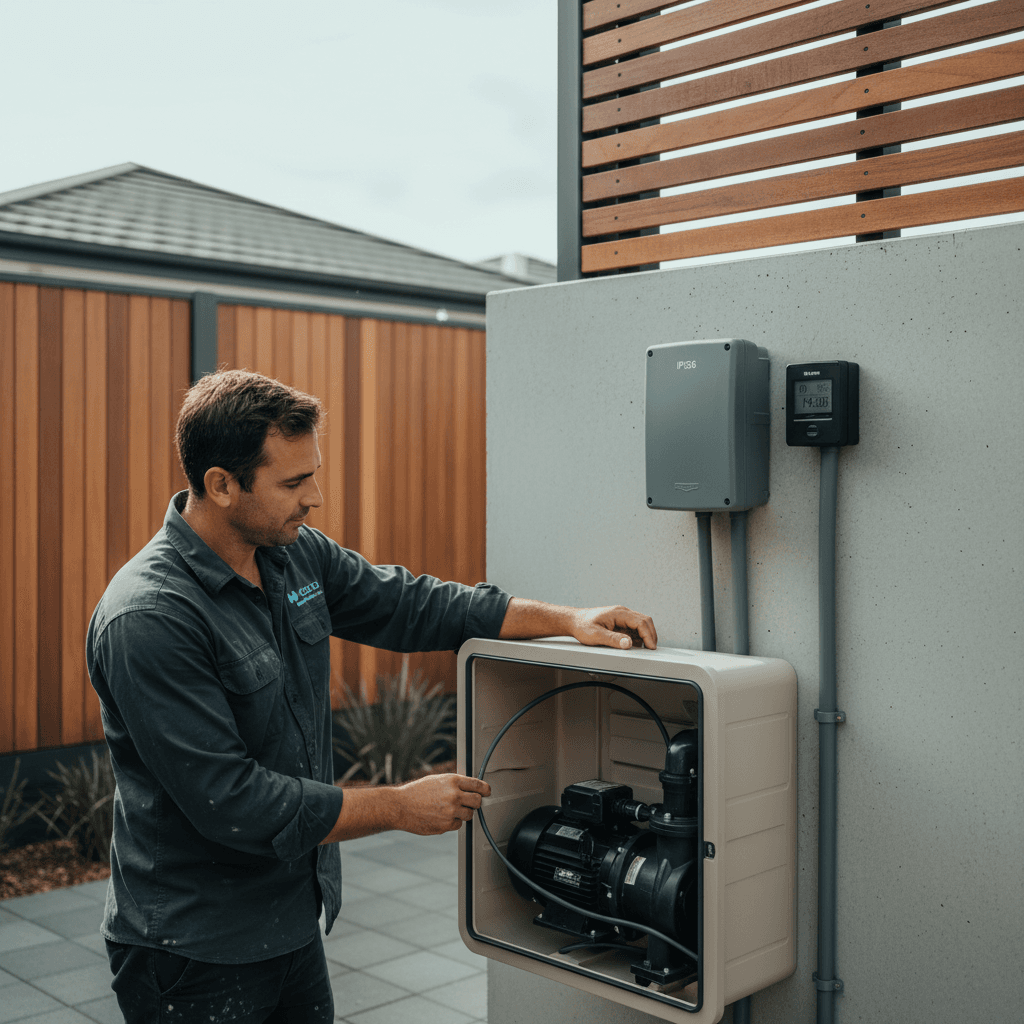
Pool pump wiring is one of those jobs where people think it's straightforward (it's just a motor plug, right?) until I explain what AS/NZS 3000 actually requires around water. The wiring rules have strict IP, zone and RCD requirements for any electrical equipment near a pool, and pool pumps get a specific set of rules.
This comes up regularly for me out in Carindale, Wakerley and Cleveland, where a lot of properties have pools built in the 1980s and 90s, and the electrical setup around them hasn't been touched since.
Pool zones and where the pump must go
The wiring rules divide the area around a pool into three zones based on proximity to the water. The main points for pool pumps:
- Zone 0 is inside the water. Nothing electrical belongs there except purpose-built pool lights with appropriate IP and voltage ratings.
- Zone 1 is the area above the pool water surface and within 1.25m horizontally of the pool edge, up to 2.5m height. Standard electrical equipment is not permitted here.
- Zone 2 extends out 1.5m beyond Zone 1 horizontally. Wiring and equipment permitted here must have enhanced protection (typically IP44 minimum) and must be on a 30mA RCD-protected circuit.
The pool pump must be located outside all three zones, which in practice means more than 1.5m + 1.25m = 2.75m from the water edge. On most Brisbane properties this means the pump is in a pump box, shed or beside the fence line, well clear of the pool deck.
This matters because I've inspected plenty of pool installations in older Cleveland homes where the pump has been sitting 1m from the pool coping on a wood deck, with the power lead running back to a standard outdoor socket. That's a non-compliant install and a shock risk, particularly for barefoot kids on a wet deck.
The dedicated circuit
A pool pump should be on its own dedicated circuit. The reasons:
- Nuisance trips. Pool pumps have a significant inrush current when the motor starts. Sharing a circuit with other loads can cause nuisance tripping, particularly on older switchboards with single-pole breakers rather than hydraulic-magnetic breakers.
- Fault isolation. If the pump develops an earth fault or the wiring at the pump end gets water ingress, a dedicated circuit means only the pool pump circuit trips, not the whole outdoor section of the house.
- Compliance. For new installations, the wiring rules effectively require the pool pump to be on its own circuit with a 30mA RCD. A shared-circuit arrangement doesn't always provide that cleanly.
Circuit rating: most residential pool pumps are 1.0-2.2kW, which puts them at 5-10A at steady state. A 16A circuit is standard. I fit a 16A RCBO at the switchboard as a matter of course: one device does both overcurrent and earth-leakage protection.
Isolator requirements
The isolating switch for a pool pump must be:
- Located outside all pool zones (i.e., more than 2.75m from the water edge, or on the wall of the building clear of the pool area).
- Within sight of the pump, so a service technician can verify isolation without leaving line-of-sight.
- Weatherproof rated (IP56 minimum for an outdoor location).
- Lockable, where practical, to prevent accidental or unauthorised energising while someone is working on the pump.
A standard 16A or 20A IP56 rotary isolator mounted on the wall adjacent to the pump enclosure covers all of these. I avoid the "piggyback" arrangement where the isolator is mounted on the pump enclosure itself, because if the enclosure ever needs replacement, the isolator moves with it.
Weatherproofing the install
Pool environments are hard on electrical equipment. Chlorine vapour, high humidity, UV and the occasional pressure-wash around the pool equipment area all take a toll.
Best practice:
- All terminations in IP56 weatherproof boxes. Not junction boxes from the hardware store. Proper rated enclosures with compression cable glands.
- UV-rated conduit for any exposed runs. Orange or grey UV-resistant PVC conduit, not standard white irrigation pipe.
- Cable entry into pump sealed. Where the supply cable enters the pump, use a proper cable gland or sealed conduit fitting, not a self-amalgamating tape wrap.
- Earthing. The pump motor casing must be earthed, and the earthing conductor should be inspected every few years because pool chemistry can corrode copper earth continuity conductors in unsealed enclosures.
Equipotential bonding is also worth mentioning here. The wiring rules require all metal within 1.25m of the pool to be connected to a common equipotential bond. This includes pool ladders, handrails, the pump casing if metal, and any metal pipework. This bond keeps all those surfaces at the same potential, so even if there's a fault somewhere, touching two points simultaneously doesn't result in current through your body. I do an equipotential bond check on every new pool pump install. See the pool electrical safety guide for more on bonding requirements.
Timer and smart controls
Pool pumps shouldn't run 24 hours a day; they run to turn over the water volume, typically 6-8 hours in Brisbane summer, 4-6 hours in winter. A timer is not a compliance requirement but it's standard practice.
Options:
- Mechanical dial timer: Cheap, reliable, $40-$80. Mounts in a weatherproof enclosure on the isolator circuit. Fine for a standard single-speed pump.
- Clipsal C-Bus or similar relay: Allows remote scheduling from a smartphone app. $150-$300 extra.
- Variable-speed pump with built-in controls: Many modern pool pumps (Viron, Davey, Pentair VS) have an integrated controller with scheduling, ramp-up settings and remote app control. The electrical supply still needs to be compliant; the smarts are in the pump.
For most Brisbane homes, I fit a mechanical 24-hour timer with off-peak scheduling: pump runs in the early morning (when power is cheaper) and tops up in the evening if needed. Simple, reliable, costs nothing to operate.
Install cost guide
2026 Brisbane pricing for a pool pump electrical install:
- New pump on existing compliant circuit and isolator: $180-$280 (reconnection only).
- New dedicated 16A circuit + RCBO + IP56 isolator, existing switchboard with space: $480-$750.
- Above + switchboard upgrade needed (no spare pole positions): $1,800-$2,600.
- Full rework of non-compliant older install (wrong zone placement, no RCD, non-IP rated fittings): $750-$1,400.
If you've got a pool in Carindale, Wakerley or Cleveland and you're not sure the electrical setup around it is compliant, call 0411 054 811 for a straightforward inspection. I'll tell you exactly what's there and what, if anything, needs fixing.
, John
I'm John, local Camp Hill sparky, fully licensed, fixed-price quotes, lifetime workmanship warranty. Ring me direct on 0411 054 811 or send a quick message.
Keep reading
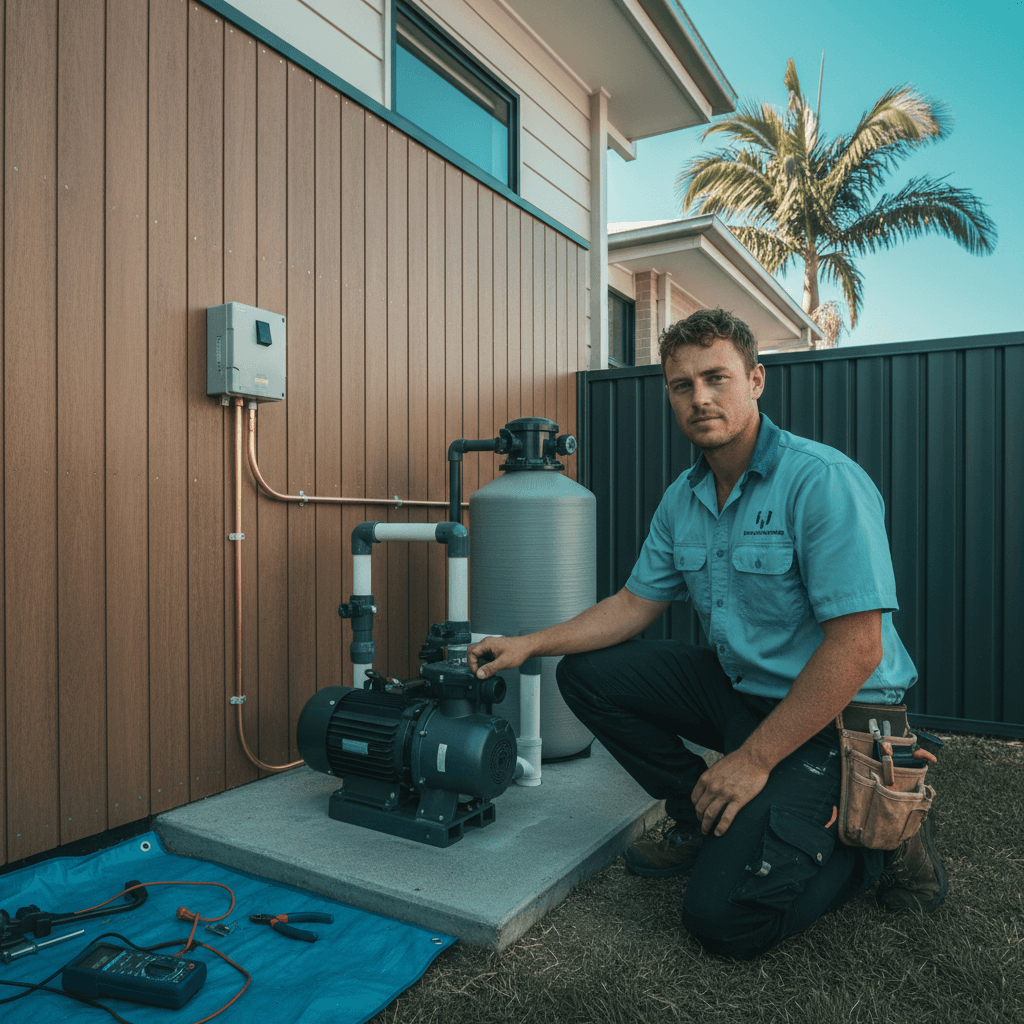
Pool & spa electrical safety in QLD: the rules every Brisbane pool owner should know
Bonding, earthing, IP-rated lights, RCDs, the AS/NZS 3000 zones around the water and the cabinet rules. What's mandatory, what's smart.
Renovation electrical checklist for Brisbane homes (the one your builder won't give you)
What to think about *before* the walls go back up. The 12-point electrical checklist for Brisbane renovations, from powerpoint locations to data cabling.