
Pool & spa electrical safety in QLD: the rules every Brisbane pool owner should know
Bonding, earthing, IP-rated lights, RCDs, the AS/NZS 3000 zones around the water and the cabinet rules. What's mandatory, what's smart.
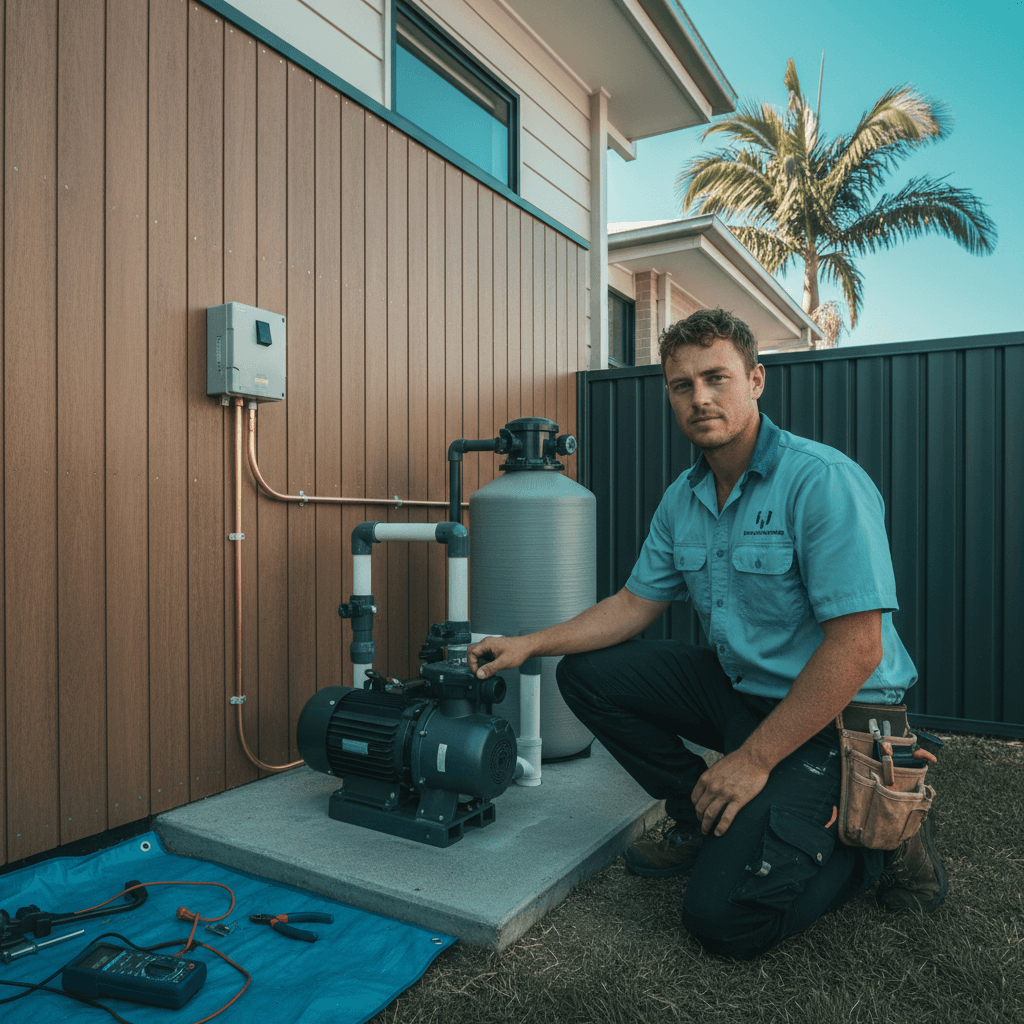
Pool electrical safety is one of those areas where the gap between what homeowners think is required and what the wiring rules actually require is consistently large. I do pool electrical work in Carindale, Wakerley and Cleveland regularly, and the conversation almost always starts with a homeowner who knows their pool fence compliance inside out but has never heard of equipotential bonding.
The stakes are higher than in most domestic electrical work. Water is an efficient conductor. Human bodies in water have low resistance. Electrical faults near pools can be fatal and they can be subtle; there are documented cases of electrocution in pools with no visible signs of electrical damage.
Here is what the rules require and why each one exists.
The three electrical zones around a pool
AS/NZS 3000 (the wiring rules) defines three zones around a swimming pool or spa, each with different requirements for electrical equipment:
Zone 0 is the interior of the pool or spa, the water itself and the surfaces immediately bounding it. Almost no electrical equipment is permitted in Zone 0. Pool lights installed within the pool shell are a specialised exception and must be rated to a very high ingress protection standard and operated at extra-low voltage via a safety isolating transformer.
Zone 1 extends from the pool wall or edge to a horizontal distance of 1.5 metres outward and upward to a height of 2.5 metres above the water surface. Equipment in Zone 1 must be specifically rated for use in wet environments (IP rating appropriate to the zone) and must be connected through an RCD. No socket outlets, no general-purpose equipment, no standard light switches.
Zone 2 extends from the outer edge of Zone 1 to a further 1.5 metres outward (so 3 metres total from the water edge). Socket outlets are permitted in Zone 2 but must be RCD-protected and IP-rated. General electrical equipment is permitted but must be appropriate for the environment.
In practice: most pool pumps, filter equipment, and outdoor entertainment areas fall within Zone 1 or Zone 2. The requirements for those zones are substantially stricter than for standard domestic installations.
Equipotential bonding: the rule nobody tells you about
This is the one I find most consistently absent in older Brisbane pools.
Equipotential bonding (sometimes called "supplementary bonding") requires that all metal components within the pool Zone 1 area be electrically connected to each other and to the earthing system. This includes:
- The pool shell reinforcing (if steel-reinforced concrete).
- Metallic pool ladders, handrails, and steps.
- Metallic parts of the pool light fittings.
- The pool pump motor housing.
- Any metallic pipes or conduit within the zone.
- Metallic components of water features connected to the pool.
The purpose: if a fault develops anywhere in the pool electrical system, equipotential bonding ensures that no dangerous voltage gradient exists between metal objects within the zone. Without bonding, a person touching two metal objects (the ladder and the pool light, for example) could experience a voltage difference between them even if neither object is obviously live.
This is not a hypothetical concern. The failure mode is called "voltage gradient" electrocution, and it does not always require a dramatic short circuit or arc. A slow current leak from a failing pool light can establish a voltage gradient in the water sufficient to cause muscle paralysis and drowning.
Bonding conductor: typically 6mm copper, run from a dedicated bonding terminal at the pool equipment cabinet to each metal item. This bonding conductor does not carry current in normal operation; it is purely a fault-protection measure.
RCD requirements for pool equipment
All electrical circuits serving pool equipment must have 30mA RCD protection. This applies to:
- The pool pump motor circuit.
- The pool light circuit.
- Any socket outlets in Zone 1 or Zone 2.
- The pool heating circuit (heat pump or gas heater ignition circuit).
- Any automatic dosing or chemical control equipment.
The RCD must be installed at the switchboard or in the pool equipment cabinet and must be accessible for testing. The T-button test on pool equipment RCDs should be performed at the start of each pool season, or every three months if the pool is used year-round. This is not optional.
A common problem I find in older Brisbane pool installations: the pool pump is on a shared circuit with outdoor power, protected by a single shared RCD. While this might have met the requirements at the time of installation, it means a fault on any appliance on that shared circuit can cause the pool pump to lose power, and fault diagnosis is harder. The modern approach is a dedicated circuit and RCBO for the pool pump.
The pool pump and equipment cabinet
The pool equipment cabinet (the area housing the pump, filter, and chlorinator) has specific requirements:
- Dedicated circuit from the main switchboard or a sub-board. Do not share a pool pump circuit with outdoor power outlets.
- IP56 or better isolator mounted within sight of the pump and accessible without tools for emergency isolation. This is the weatherproof switch you use to turn the pump off without going back to the switchboard.
- Weatherproof enclosure for any electrical components housed in the cabinet. The internal wiring must be protected from moisture, chemical fumes from chlorine, and pest ingress.
- RCD on the circuit, 30mA, tested regularly.
- Bonding terminal accessible within the cabinet to connect the bonding conductors from around the pool.
- Labelling of the isolator and any other controls within the cabinet so that the function of each switch is clear.
The cabinet itself should not be the location of the main switchboard protection. The circuit breaker and primary RCD for pool equipment should be in the house switchboard or a dedicated outdoor sub-board, not inside the wet equipment cabinet.
When a compliance certificate is required
A Certificate of Test is required for any new electrical work associated with a pool, just as it is for other electrical installations. This includes:
- New pool construction (the electrical installation is part of the overall QBCC permit and requires a sparky's certificate).
- Addition of a pool heat pump, new lighting, or additional equipment to an existing pool.
- Relocation of the pool pump or equipment cabinet.
- Any rectification work following a failed inspection.
For existing pools where no new work has been done, there is no routine certificate requirement for homeowners. However, if you are selling a property with a pool and the buyer's inspection identifies electrical compliance issues, you will need to rectify and certify before settlement.
What I fit on a typical Brisbane pool
When I do a pool electrical installation or upgrade in Carindale or Cleveland, the standard scope includes:
- Dedicated RCBO at the main switchboard for the pool pump circuit.
- IP56 isolator at the equipment cabinet, correctly labelled.
- Check and, where needed, installation of equipotential bonding conductors to all metal components.
- Replace any non-IP-rated electrical enclosures in the cabinet.
- Test all RCDs and document results.
- Check pool light transformer rating and earth continuity on the pool light circuit.
- Certificate of Test on completion.
Typical cost for an upgrade of an existing Brisbane pool electrical installation (pump circuit, bonding, isolator, certificate): $550-$1,100 depending on the complexity of the existing installation and the cable runs required.
New pool installations as part of a build are quoted as part of the overall project scope, typically $1,200-$2,200 for the pool electrical alone.
If you have an older Brisbane pool and you are not confident the electrical installation meets current requirements, ring 0411 054 811. We will do a compliance check and quote any rectification work at the same visit.
, John
I'm John, local Camp Hill sparky, fully licensed, fixed-price quotes, lifetime workmanship warranty. Ring me direct on 0411 054 811 or send a quick message.
Keep reading
Renovation electrical checklist for Brisbane homes (the one your builder won't give you)
What to think about *before* the walls go back up. The 12-point electrical checklist for Brisbane renovations, from powerpoint locations to data cabling.
Safety switches explained: what they do, how to test them, and why one isn't enough
Safety switches are the device that saves your life when an appliance faults. Here's how they work, why most Brisbane homes don't have enough of them, and how to test the ones you've got.