
How to read your switchboard labels (so the next sparky doesn't charge you to figure it out)
A 5-minute walkthrough of what every label, symbol and acronym in your switchboard actually means. Print it, tape it inside the door.
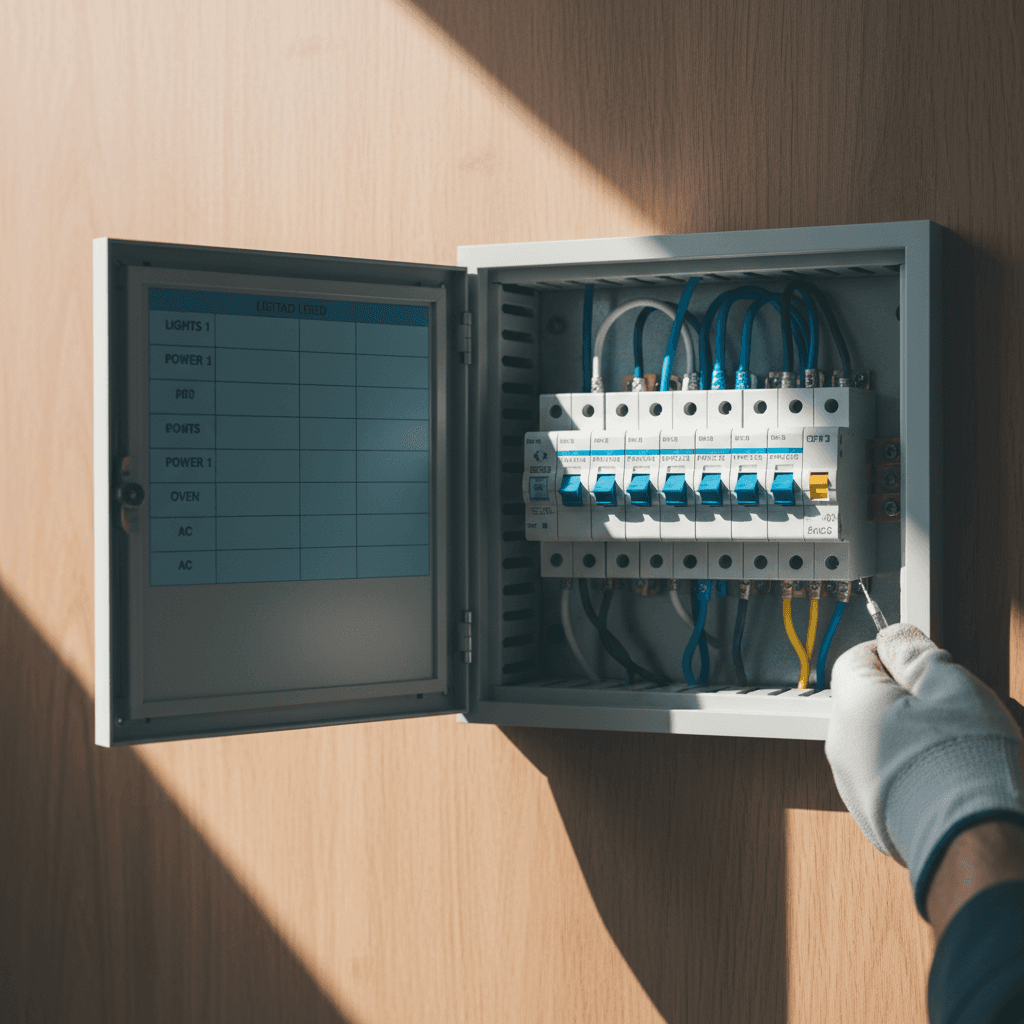
Every sparky who has ever opened an unlabelled switchboard has had the same thought. It costs the homeowner money and it wastes my time, and more importantly, it means that in an emergency the person trying to isolate a circuit has no idea what to turn off.
A proper switchboard label is not optional under AS/NZS 3000. It is required. But a lot of older boards, and even some newer ones done by less careful sparkies, have labels that are wrong, faded, or so vague as to be useless ("Power 1", "Lights", "Misc").
Here is the plain-English guide to everything you will see on a well-labelled switchboard.
Why switchboard labels matter more than you think
The practical reason: when an appliance starts sparking and someone needs to kill the circuit immediately, they need to find the right breaker in under 30 seconds. "GPO East" does not help when you do not know which wall is east.
The legal reason: if a licensed sparky does work on your board and submits a Certificate of Test, they are certifying that the board is labelled correctly. That label sheet is a legal document.
The money reason: every time a sparky opens your board and cannot tell what does what, they spend 10-15 minutes tracing circuits before they can do actual work. At Brisbane sparky rates, that is $60-$100 wasted before a screw is touched.
If your board labels are missing, wrong, or made with a Dymo label maker from 2003, ask me to redo them when I am next on-site. It takes about 20 minutes and is genuinely one of the most useful things I do.
The main switch (MS)
The main switch is usually at the top left of the switchboard. It will be wider than the circuit breakers, rated at a higher current (63A, 80A, or 100A for most Brisbane homes), and labelled MS or Main Switch or sometimes just MAINS.
Turning this OFF de-energises every circuit in your home. The supply side of the main switch, the conductors coming in from the Energex meter, remains live even with the main switch off. Do not touch those.
Some main switches have a padlock lug on them. This allows the switch to be locked in the OFF position for maintenance. If you see a lock there, that is deliberate.
In a 3-phase home, the main switch will be a 3-pole or 4-pole unit and considerably wider than in a single-phase board.
MCB, RCD and RCBO: what they mean on the label
On the device itself, you will typically see these markings:
MCB (Miniature Circuit Breaker): Standard breaker, no test button. Just a rocker switch. Does not protect against shock, only against overcurrent.
RCD (Residual Current Device or Safety Switch): Wider than an MCB, has a "T" test button. Protects against earth leakage. Often one RCD covers multiple circuits via separate MCBs. Older boards commonly have two: one for power circuits, one for lighting.
RCBO (Residual Current Circuit Breaker with Overcurrent protection): One device per circuit, with both MCB and RCD functions. You can identify these because they have both a rocker switch and a test button, and they are one per circuit in the label sheet. Modern standard.
The label sheet should indicate which device covers which circuits. A well-labelled modern board will have something like:
- Circuit 1, RCBO 16A: Kitchen GPO North
- Circuit 2, RCBO 16A: Kitchen GPO South
- Circuit 3, RCBO 10A: Kitchen Rangehood
And so on.
The numbers: what amp ratings mean
Every breaker and RCBO has an amp rating stamped on it. Common values in Brisbane homes:
- 6A: Usually a lighting circuit in an older home, or a very low-draw dedicated circuit
- 10A: Standard lighting circuit, or low-load power circuit
- 16A: Most general power circuits (GPO = general purpose outlet, which is a powerpoint)
- 20A: Heavier power circuits, some air conditioning circuits, hot water systems
- 25A or 32A: Dedicated high-load circuits, stove, large AC, EV charger (7.4kW single-phase)
- 63A or 80A: Main switch rating for the whole house supply
Bigger is not better. The amp rating of a breaker should match the wire behind it. If someone has put a 32A breaker on a circuit wired with cable rated for 20A, the breaker will allow the cable to overheat before it trips. That is a fire risk. The wiring rules are specific about this matching.
What "P" means on a breaker: P = Poles. A 2P breaker switches two conductors simultaneously (active and neutral), used on some 240V dedicated circuits. A 3P or 4P breaker is for 3-phase circuits.
Circuit name conventions
The label sheet inside your switchboard door should name every circuit in terms that tell you exactly what is on it and roughly where. Good label conventions:
- Compass or room-based names: "Kitchen GPO", "Bedroom 1 Lights", "Back Patio GPO"
- Load type: "AC Unit - Study", "Hot Water System", "Garage Roller Door", "EV Charger"
- External vs internal: "External Lights", "Garden GPO"
Labels to avoid, because they tell you nothing:
- "Power 1", "Power 2"
- "Lights" (which lights? How many rooms?)
- "Spare" (there should not be truly blank circuits on a completed install)
When I do a switchboard upgrade, I trace every circuit before labelling it. This occasionally reveals surprises, circuits that were labelled as lighting but are actually running outdoor power, circuits with two rooms on them that should have been separate. The label sheet I leave is accurate to what I tested.
What a proper label sheet looks like
A proper label sheet is mounted inside the switchboard door and covers:
- Board identifier (address, installation date, sparky name and licence number)
- Each circuit: device number, device type and rating, circuit description
- A note of which RCD covers which circuits if they are separate from the circuit breakers
- The SPD status indicator location if fitted
- Emergency contact number
When I finish a job, I also give the homeowner a PDF copy of the circuit list. If you do not have a digital copy of your switchboard label, ask your sparky for one at the next service visit.
If your board is labelled with mystery acronyms, masking tape handwriting, or just blank, ring me on 0411 054 811 and I can do a label audit as part of any service visit. It takes about 30 minutes and is worth doing.
, John
I'm John, local Camp Hill sparky, fully licensed, fixed-price quotes, lifetime workmanship warranty. Ring me direct on 0411 054 811 or send a quick message.
Keep reading
7 signs your switchboard needs upgrading (and why Brisbane homes are usually first in line)
Trips when the kettle's on. Burnt-plastic smell. Ceramic fuses. The seven signs your old switchboard is on its way out, and what a modern compliant board actually looks like.
Old fuse box vs modern switchboard: a side-by-side guide for Brisbane homes
What's the actual difference between a 1970s ceramic-fuse box and a 2026 RCBO switchboard? A side-by-side breakdown of safety, compliance and cost.