
Caravan & RV power outlet at home: the QLD rules so you can't legally fry the van
Plugging your caravan into a regular powerpoint is illegal. The 15A or 32A weatherproof outlet, the RCD requirements, and the install cost.
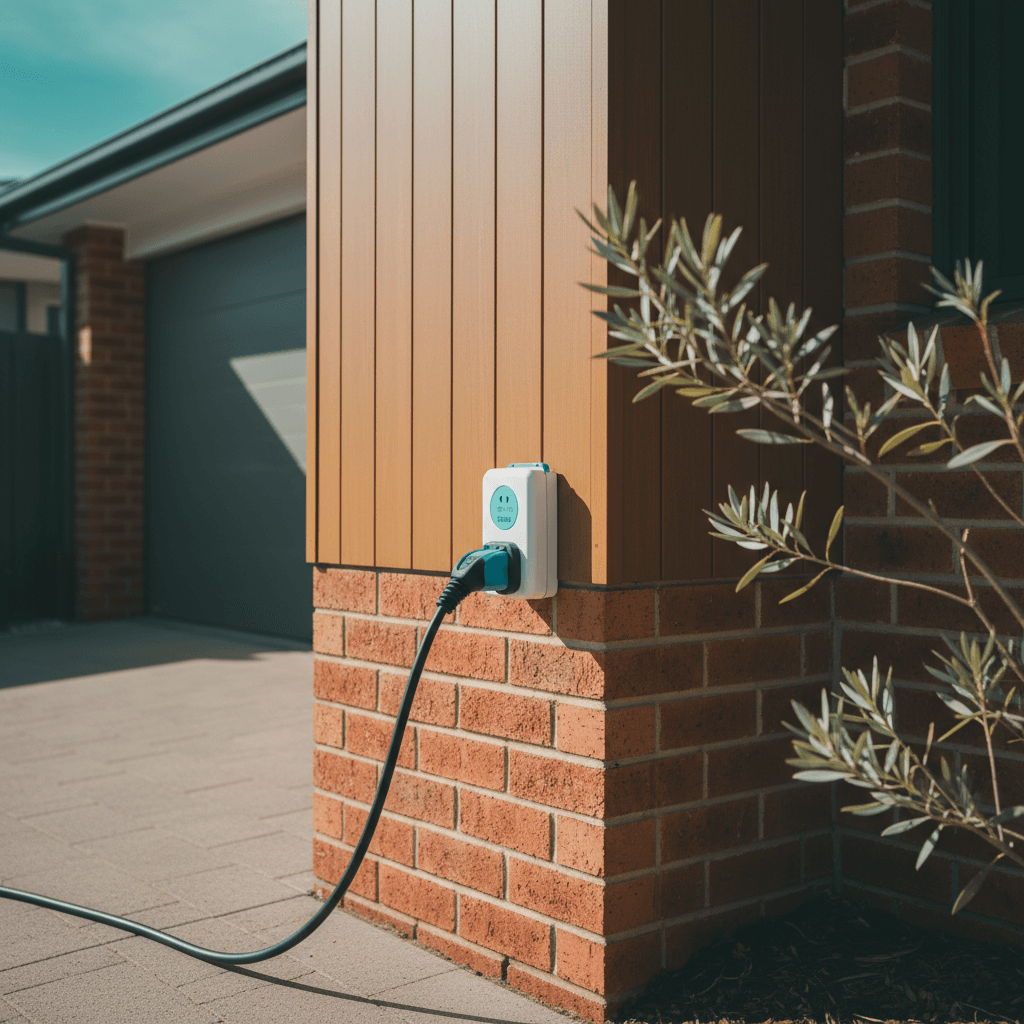
If you've got a caravan or campervan sitting in the driveway and you've been plugging it into the regular powerpoint on the side of the house, there's a chance you're doing something that's both illegal and that will eventually damage the van's electrical system. The standard 10-amp domestic powerpoint is not designed for caravan loads, and the plug doesn't fit anyway without an adapter, which is itself a sign you're doing something the rules don't intend.
I get this call a fair bit from Wynnum and Manly, where there are a lot of caravans and RVs sitting in driveways next to fibro houses with elderly wiring. Here's how to do it properly.
Why a standard 10A powerpoint won't do
A standard domestic powerpoint in Australia is rated at 10 amps and 2,400 watts at 240V. A typical caravan or RV on shore power draws significantly more than that during normal use: the air conditioner alone on a medium caravan can pull 8-10 amps at 240V, and with the kettle, microwave, and battery charger running simultaneously, you're well past 10A.
Running a 10A powerpoint at or above its rated load continuously is a fire risk. The plug, outlet, and cable heat up. If the house's wiring is elderly and undersized, that problem compounds along the entire circuit.
Beyond the load issue, there's the plug: a 10A domestic outlet uses a standard AS/NZS 3112 plug. Caravans are designed to connect via a 15A round-pin connector (per AS/NZS 3112 also, but the 15A variant, which physically can't plug into a 10A outlet). If you're using an adapter to get around that, you've bypassed the physical protection system.
15A vs 32A: which one you need
15A outlet: This is the standard for most residential caravans, campervans, and trailer kitchens. It uses a three-flat-pin configuration with a larger earth pin, physically incompatible with 10A domestic outlets and appliances. Rated for continuous caravan loads. IP-rated (weatherproof) versions are required for external installation.
32A outlet: Only needed if you have a very large motorhome, a three-phase connection, or you want to rapid-charge a battery system. Most caravans don't need 32A at home; that's more of a commercial caravan park situation. If your van's documentation says it requires a 32A supply, that's a different installation requiring heavier cabling and a different outlet.
For 95% of Brisbane homeowners, a single 15A weatherproof outlet is what you need.
RCD protection requirements
The circuit supplying the caravan outlet must have RCD (safety switch) protection, rated at 30mA trip current. This is a requirement under the wiring rules for any circuit with a socket outlet used in an outdoor or accessible location.
This means either:
- An RCBO (combined RCD and circuit breaker) in the switchboard dedicated to that circuit, or
- A separate 30mA RCD in the switchboard covering the circuit.
A standard circuit breaker without RCD protection is not acceptable for this installation.
Your caravan almost certainly also has its own internal RCD at the caravan's consumer unit. Good. That's an additional layer of protection, not a substitute for the one at the house switchboard.
Earth fault and the caravan's own protection
One thing people don't think about: when you connect a caravan to shore power, the caravan becomes an extension of the house's electrical system. If there's an earth fault in the caravan, the fault current needs a path to earth through the outlet's earth conductor back to the house switchboard. A proper 15A outlet includes a correctly sized earth conductor for exactly this reason.
This is also why AS/NZS 3001, the standard specifically covering electrical installations in caravans and recreational vehicles, requires that the shore power inlet and wiring inside the van are maintained. A damaged inlet or corroded connections inside the van turn the van into a fault waiting to happen, regardless of how well the house outlet is installed.
If your van has been sitting for a few years and you're not sure of its internal electrical condition, get the van's wiring checked by someone familiar with AS/NZS 3001 before you plug it in.
What the install actually involves
A typical caravan outlet installation at a Wynnum or Capalaba home:
- Assess the existing switchboard for a spare circuit breaker position (or RCBO slot). If the board is full, the board needs attention first.
- Run new 4mm² TPS cable from the switchboard to the outlet location (heavier cable than a domestic circuit because of the 15A load).
- Install an RCBO rated for 20A or 25A (depending on the cable run length and derating) to protect the circuit. The 15A outlet is the limiting device.
- Mount the weatherproof 15A outlet on the external wall, in conduit where the cable is surface-mounted, IP56-rated.
- Test insulation resistance, polarity, earth continuity, RCD trip time.
- Issue Certificate of Test.
The whole job takes 3-4 hours for a straightforward installation. If the switchboard needs attention, add time.
Cost in Brisbane 2026
For a typical straightforward installation on a Wynnum or Manly home:
- Standard 15A caravan outlet, new circuit from switchboard: $380-$550.
- If the switchboard needs an RCBO added and there's an available slot: add $80-$120.
- If the switchboard is full or needs upgrading to accommodate the circuit: the switchboard upgrade cost applies separately, typically $1,650-$2,400 for a standard single-phase board.
You can also have the outlet installed when adding other powerpoints to the exterior, which reduces mobilisation cost.
Do not use an extension cord as a permanent solution. I see this constantly: a domestic extension cord run from the house, plugged into a 10A socket, permanently coiled on the ground under the van. Extension cords are rated for occasional temporary use, not continuous load. A permanently deployed extension cord carrying near its rated load will heat up, and extension cord connections corrode and arc over time. The Fire and Emergency Services Authority has well-documented case studies on caravan fires involving extension cords.
Weatherproof cover: The outlet itself needs a lockable or spring-loaded weatherproof cover. This is not just a waterproofing requirement; it also stops insects, spiders, and general debris getting into the outlet when the van is not plugged in. SE QLD outdoor electrical fittings without weatherproof covers have a relatively short life in our climate.
Cable run routing: Where the sub-main cable runs externally (along the outside of the house or around the perimeter of the property), it must be run in weatherproof conduit. Surface-mounted cable on an exterior wall without conduit is not compliant and will degrade in Brisbane's UV and heat within a few years.
If you're in Wynnum, Manly, or Capalaba and you want a compliant 15A outlet for the van, ring 0411 054 811 and I'll give you a firm quote on the day.
, John
I'm John, local Camp Hill sparky, fully licensed, fixed-price quotes, lifetime workmanship warranty. Ring me direct on 0411 054 811 or send a quick message.
Keep reading
Adding powerpoints to a Queenslander: how to do it without ruining the floors
Queenslanders look beautiful and were wired terribly. Here's how to add powerpoints to one without lifting every floorboard or chasing every wall.
Renovation electrical checklist for Brisbane homes (the one your builder won't give you)
What to think about *before* the walls go back up. The 12-point electrical checklist for Brisbane renovations, from powerpoint locations to data cabling.