
AS/NZS 3000 in plain English: the wiring rules that protect your house
The Wiring Rules are 700 pages of standards. Here's the 12 things in there that actually affect a Brisbane homeowner, summarised.
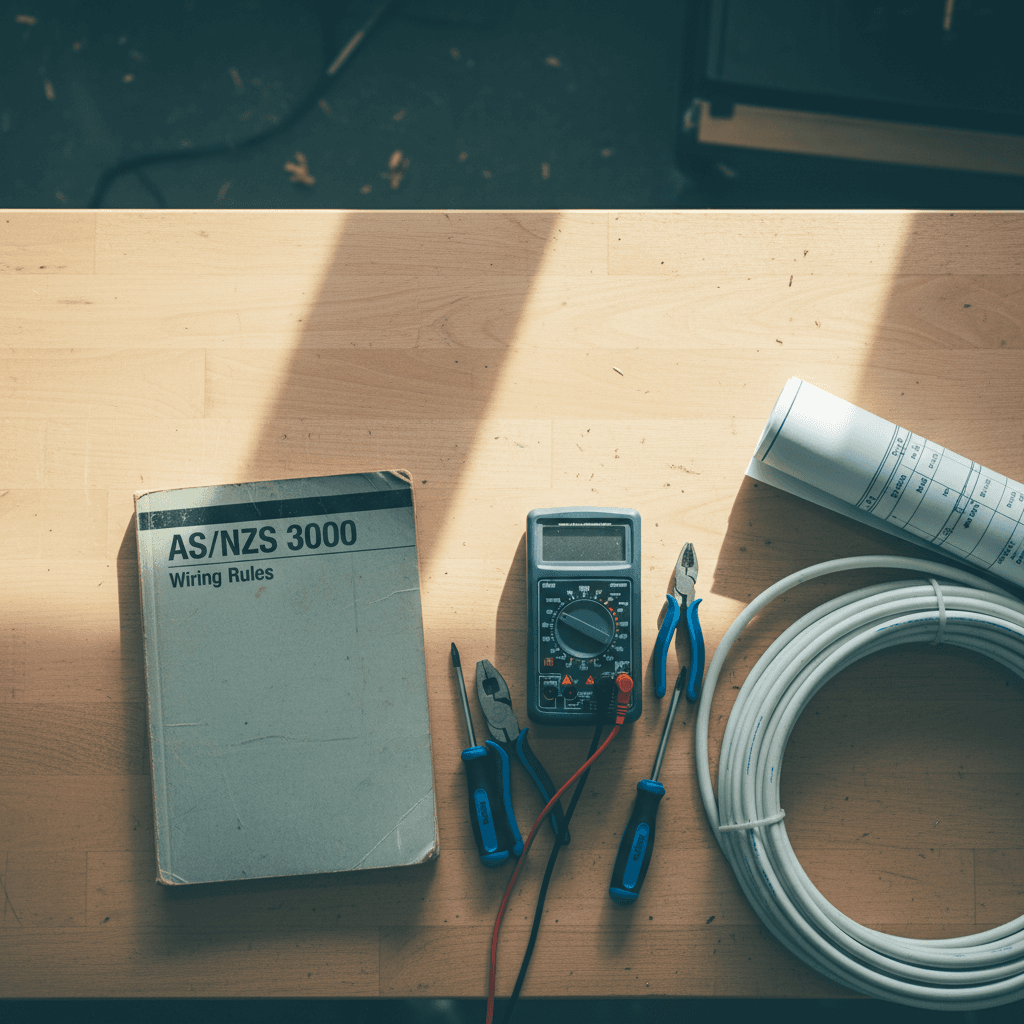
AS/NZS 3000, or "the Wiring Rules" as sparkies call it, is around 700 pages of technical standards covering how electrical installations must be designed, built, and tested in Australia and New Zealand. It's not light reading. But buried in those 700 pages are rules that directly affect whether your home's wiring is legal, safe, and insurable.
I'm not going to quote clause numbers at you. Instead, here are the twelve things in the Wiring Rules that most frequently show up in real Brisbane homes, explained in terms a homeowner can actually act on.
What AS/NZS 3000 actually is
The Wiring Rules are a joint Australian and New Zealand standard, maintained by Standards Australia. They are incorporated into QLD law through the Electrical Safety Regulation 2013, which means compliance is a legal obligation, not a suggestion. Any electrical installation work carried out by a licensed electrician in QLD must comply.
The standard covers everything from cable sizing and earthing to switchboard labelling and testing procedures. It's updated periodically; the current version is AS/NZS 3000:2018 with amendments published since then. When an older home was built, it was built to the version current at the time. Upgrades must meet the current version.
This matters for homeowners: your 1970s house was legally built to the 1970s standard. But any new work done on it today must meet the 2018 (and current amendment) version. That's why renovations often surface wiring that was "fine when it was put in" but can't be extended further without upgrading.
RCD requirements
The Wiring Rules require residual current devices (RCDs, or safety switches) on all circuits in a domestic installation. This is the rule that most frequently comes up when I'm inspecting older Camp Hill and Carina homes.
The requirement that matters for homeowners:
- Every socket outlet circuit must have RCD protection. That means every circuit supplying powerpoints.
- Every lighting circuit must have RCD protection.
- Final sub-circuits for fixed appliances in wet areas (bathrooms, laundries, kitchens) must have RCD protection.
- The RCD must trip within 300 milliseconds at 30mA of leakage current. That's the threshold below which cardiac fibrillation is unlikely for a healthy adult.
In practice, a modern switchboard has either circuit-breaker-plus-RCD combos (RCBOs) on each circuit, or separate RCDs covering groups of circuits. Both are compliant. See safety switches explained for more on the difference.
Pre-2000 Brisbane homes often have no RCDs at all, or a single RCD covering the whole house (which trips everything when one fault occurs). Neither arrangement meets today's standard for new work.
Earthing and the MEN connection
Earthing is the most critical safety system in any electrical installation and the one most homeowners understand the least.
The Wiring Rules require a Multiple Earthed Neutral (MEN) connection at the main switchboard: a link between the neutral bar and the earth bar, combined with an earthing conductor running to an earth stake or the water main or both. This connection is what makes the system safe when a fault occurs: fault current has a low-impedance path back to the source rather than through you.
What homeowners need to know:
- The MEN connection must exist and must be intact at the main switchboard.
- Every earthed accessory (powerpoints, light fittings, metal switch plates) must have a continuous earth conductor back to the earth bar.
- Earth conductors must be adequately sized: not the smallest wire in the bundle.
- If your switchboard is a plastic panel with no earth bar, that's a problem.
I find faulty or missing earth connections in postwar Brisbane homes with alarming regularity. It's invisible until there's a fault, at which point it's very visible.
Cable sizing and derating
The Wiring Rules have detailed tables specifying the minimum conductor size for a given circuit length, load, and installation method. The homeowner takeaways:
- A 2.5mm² TPS cable on a 20A circuit is the standard for most power circuits.
- A 1.5mm² TPS is standard for lighting (usually a 10A circuit).
- Derating applies when cables are bundled together or run through thermal insulation. A cable that's rated for 20A in free air might only be rated for 14A when it's running through ceiling insulation. Installers must account for this.
- Aluminium wiring (common in 1970s-1980s Brisbane homes) has different derating rules and requires special connectors. Standard copper connectors corrode against aluminium. This is a specific hazard in older Carindale and Camp Hill homes.
Wet areas and IP zones
The Wiring Rules define protection zones in bathrooms and around swimming pools based on proximity to water. In bathrooms:
- Zone 0 is inside the bath or shower enclosure itself. Only special equipment rated IPX7 (submersible) is permitted here.
- Zone 1 is directly above the bath or shower up to 2.25 metres height. Equipment here must be rated at least IPX4 (splash-proof).
- Zone 2 extends 0.6 metres horizontally outside the bath or shower. Same IPX4 minimum.
- Socket outlets (powerpoints) must not be installed in Zone 1 or Zone 2. Full stop.
The shaver outlet you sometimes see above the vanity is specifically designed for that application and is permitted at least 3 metres from the nearest shower rose. Standard powerpoints in bathrooms are not permitted in the splash zones.
Most renovation electrical problems I see in Camp Hill and Carina bathrooms come from homeowners or handymen installing a standard powerpoint inside a bathroom without understanding these rules.
Installation practices
The Wiring Rules specify how cables must be installed, not just what size they are:
- Cables must be protected where they pass through structural timbers (via grommets).
- Cables must be secured at regular intervals and not left drooping freely in ceiling spaces.
- Cable must not be run through areas where it's mechanically vulnerable without conduit protection.
- Joints must be made in accessible junction boxes, not buried in walls.
- All wiring must be labelled or identifiable: a sparky coming in after me should be able to understand what I ran and why.
These rules exist because poorly installed cable is how fires start. A cable stapled tight over a joist, abraded over years, eventually fails. Buried joints oxidise and arc. Drooping cables in ceiling spaces snag and chafe.
Testing before energising
One of the most important and most skipped requirements: the Wiring Rules mandate a set of tests before any new installation is energised for the first time. These include:
- Insulation resistance test: confirms no cable has a fault to earth or between conductors.
- Polarity test: confirms active and neutral are not reversed.
- Earth continuity test: confirms every earthed accessory has a continuous earth path.
- RCD trip-time test: confirms each RCD trips within the required time at the specified leakage current.
- Loop impedance test: confirms the fault loop impedance is low enough for the protective device to operate.
All results must be recorded on the Certificate of Test that your sparky issues at the end of the job. If you've had work done and never received a Certificate of Test, you can't prove the work was tested. That matters for insurance and for resale.
Why this matters for your home
The Wiring Rules aren't bureaucratic box-ticking. Every rule in there was written in response to something that went wrong and hurt someone. The earthing rules come from electrocution events. The wet area rules come from people being shocked in bathrooms. The RCD rules come from decades of data showing that 30mA protection saves lives in a measurable, documented way.
As a Brisbane homeowner you don't need to know the Wiring Rules front to back. What you do need to know:
- Any licensed sparky must follow them. If they don't, they're breaking QLD law.
- Compliance with the rules is what makes work certifiable, insurable, and safe.
- DIY electrical work in QLD is very limited precisely because unlicensed work can't be certified.
- Older Brisbane homes often don't comply with the current version of the rules, but that doesn't mean they need to be fully rewired immediately. It means any new work must bring that circuit up to standard.
If you've got specific concerns about the electrical safety of a Camp Hill, Carina, or Carindale home, ring me on 0411 054 811 for an honest assessment.
, John
I'm John, local Camp Hill sparky, fully licensed, fixed-price quotes, lifetime workmanship warranty. Ring me direct on 0411 054 811 or send a quick message.
Keep reading
Safety switches explained: what they do, how to test them, and why one isn't enough
Safety switches are the device that saves your life when an appliance faults. Here's how they work, why most Brisbane homes don't have enough of them, and how to test the ones you've got.
DIY electrical work in QLD: what's legal, what's not, and what'll get you fined
QLD has some of Australia's strictest electrical-DIY laws. Here's what you can do as a homeowner, what you can't, and the actual penalties.