
Arc Fault Detection Devices (AFDDs) in Australia: do you actually need one yet?
AFDDs catch the dangerous low-current arcs RCDs miss. Here's where AS/NZS 3000 stands today, the price, and the rooms I'd fit one in voluntarily.
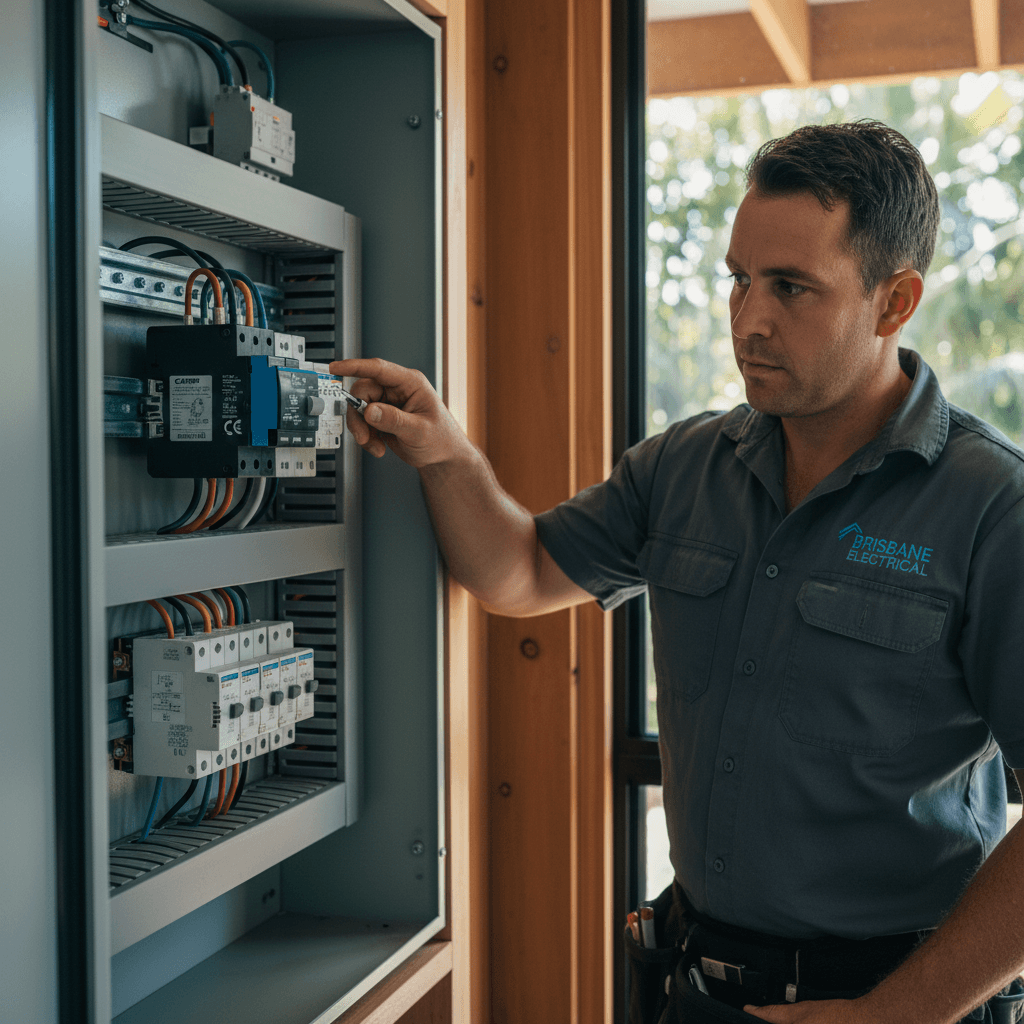
Arc Fault Detection Devices are not yet mandatory in Australian homes. If you are reading this to find out whether you legally need to fit one right now, the answer is no, not yet. If you are reading this to find out whether they are worth considering anyway, that is a more interesting question.
Here is the honest picture on AFDDs in 2026 Australia, including where the standard is heading and the specific situations where I recommend them to Brisbane homeowners without any regulatory push behind me.
What an arc fault actually is
When electrical current jumps a gap, or follows an unintended path through degraded insulation or a damaged conductor, it can create a sustained electrical arc. An arc is essentially a continuous spark. It is extremely hot (temperatures in the thousands of degrees), it produces toxic gases, and it is one of the leading causes of electrical fires in older homes.
There are two types of arc fault relevant to home wiring:
Series arc faults happen within a circuit at a break or high-resistance joint in a conductor. A damaged extension cord, a loose terminal in a light fitting, a screw that is slowly working loose in an old junction box. The current still flows, but part of it is arcing across a gap or through char. The total circuit current does not necessarily increase. The arc generates intense heat localised to the fault point.
Parallel arc faults happen when the active and neutral conductors (or active and earth) come into direct contact, usually through insulation that has worn through. This creates a short circuit with very high current, which a standard MCB will usually catch.
The dangerous one is the series arc fault. Because the total current in the circuit does not change much, your circuit breaker has no reason to trip. The heat builds up at the fault point, inside a wall cavity, inside a junction box, inside an old rubber-insulated cable, until the surrounding material ignites.
Why your RCD won't catch it
An RCD (safety switch) detects the difference between current flowing out on the active and returning on the neutral. It trips at 30 milliamps of difference.
In a series arc fault, current is still returning on the neutral. The active and neutral currents are still roughly balanced. The RCD sees nothing unusual. It does not trip. Meanwhile, inside the wall at the fault point, there is a sustained arc heating the surrounding material.
A standard MCB is designed to trip on sustained overcurrent. A series arc fault does not necessarily draw more current than normal. So the MCB also does not trip.
This gap is where house fires start. They start inside walls, in ceiling spaces, behind switchboards, in places the homeowner never looks. By the time there is visible smoke, the fire is already established.
How an AFDD works
An AFDD replaces or supplements an RCBO at the switchboard. It monitors the current waveform on the circuit continuously. Normal loads, a fridge cycling, lights turning on, a charger drawing current, all produce recognisable waveform patterns. An arc fault produces a characteristic signature in the current waveform: rapid changes, high-frequency components, specific distortions that differ from normal load switching.
The AFDD uses signal processing to distinguish between a genuine arc fault signature and normal load switching (which can look superficially similar). When it detects a sustained arc fault signature, it trips the circuit.
This is not a perfect technology. Early AFDDs had problems with nuisance tripping on certain appliances, particularly motor-driven tools and some dimmers. Modern units are considerably better. The major brands, Hager, Schneider, Siemens, have refined the algorithms substantially.
Where the Australian standard sits in 2026
AS/NZS 3000:2018 (the Wiring Rules) does not currently mandate AFDDs for residential installations in Australia. This is different to the European situation, where AFDDs are mandatory in new residential buildings in many countries, and the US situation where AFCI protection (the American equivalent) has been required in new homes since the late 1990s.
Amendment 2 to AS/NZS 3000 introduced AFDDs into the standard as a recognised device and notes their application for certain higher-risk circuits. The language is guidance rather than mandate.
The direction of travel is clear: AFDDs are coming into Australian residential requirements. The question is when. Industry expectation is that the next revision of AS/NZS 3000 will introduce mandatory AFDD requirements for at least some circuit types, likely bedrooms and other circuits in timber-frame construction. But as of 2026, there is no specific mandate.
Where I'd fit one even without a mandate
When homeowners ask me whether to include AFDDs in a switchboard upgrade, I do not say "wait until they are mandatory." I ask them about their specific situation and give an honest risk assessment.
The circumstances where I recommend fitting an AFDD voluntarily:
Old Queenslanders with original wiring. A timber-frame Queenslander with VIR (vulcanised india rubber) insulated cables that have never been rewired is a genuinely elevated arc fault risk. The rubber insulation on VIR cable from the 1940s-1960s has typically cracked and become brittle. It is impossible to know from outside the wall where a joint is developing a problem. An AFDD on the lighting circuit and the main power circuit in a home like this gives a layer of protection that an RCD simply cannot provide.
Bedrooms in any home, particularly with old wiring. Electric blankets on old circuits are a documented arc fault risk. The repeated folding of the blanket cord damages the internal conductors progressively.
Homes where previous owners have done their own "improvements". If you have bought a home and you are not sure what has been done inside the walls over the past 50 years, an AFDD on key circuits is reasonable insurance.
Any circuit feeding a built-in enclosed space, built-in wardrobes with their own wiring, wall-mounted heaters, in-wall sound systems. Anything where a wiring fault inside an enclosed space could smoulder for a long time before any smoke is visible.
What they cost and what to expect
An AFDD device costs considerably more than a standard RCBO. In Brisbane in 2026:
- A standard RCBO: $80-$120 fitted
- An AFDD-RCBO combination: $220-$380 fitted per circuit
Fitting AFDDs to every circuit in a typical Brisbane home is not trivial. Fitting them selectively, bedroom circuits and the main living area circuit in an older home, is a more realistic recommendation. Two or three circuits: $440-$1,140 incremental cost above standard RCBOs.
For a full switchboard upgrade in a Queenslander or post-war home, ask me about including AFDDs on the bedroom circuits when I quote. It is an option worth knowing the price on.
Ring me on 0411 054 811 if you want to discuss whether AFDDs make sense for your specific home.
, John
I'm John, local Camp Hill sparky, fully licensed, fixed-price quotes, lifetime workmanship warranty. Ring me direct on 0411 054 811 or send a quick message.
Keep reading
Safety switches explained: what they do, how to test them, and why one isn't enough
Safety switches are the device that saves your life when an appliance faults. Here's how they work, why most Brisbane homes don't have enough of them, and how to test the ones you've got.
7 signs your switchboard needs upgrading (and why Brisbane homes are usually first in line)
Trips when the kettle's on. Burnt-plastic smell. Ceramic fuses. The seven signs your old switchboard is on its way out, and what a modern compliant board actually looks like.