
Single-phase vs 3-phase power: do you actually need a 3-phase upgrade in Brisbane?
Most Brisbane homes are single-phase and that's fine. The handful that genuinely need 3-phase, what the upgrade costs, and the four signs you should ring Energex.
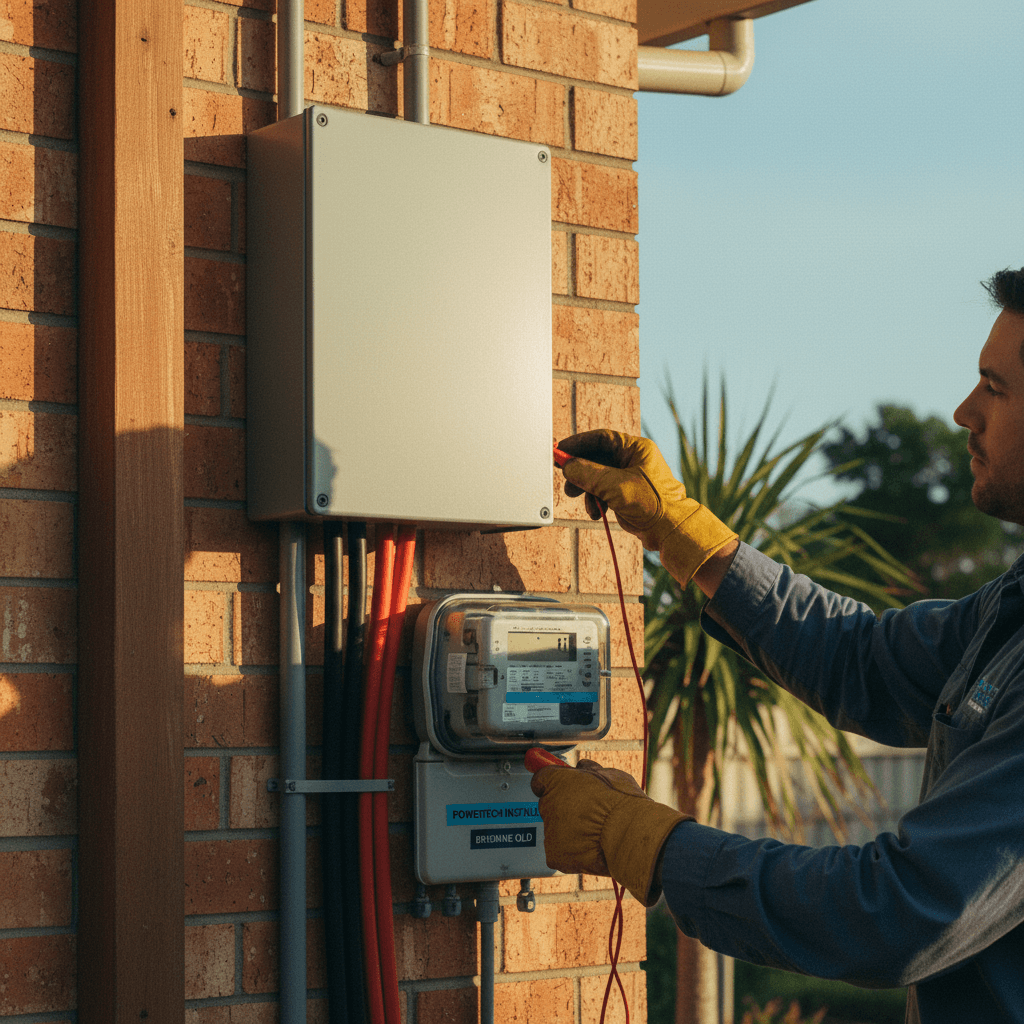
Most Brisbane homes are single-phase and they run perfectly well. When someone calls me asking about 3-phase, nine times out of ten the answer is "you probably don't need it." But that tenth time, it matters a lot. Here is the full picture so you can work out which category you are in.
What single-phase and 3-phase actually mean
The electricity that Energex delivers to your street comes from the substation as a 3-phase supply. Three live conductors, each carrying alternating current at 230 volts relative to neutral, but with their AC cycles offset from each other by 120 degrees. The reason for doing it this way is efficiency: three offset phases deliver power more smoothly than one, and large motors run better on it.
Most residential streets in Brisbane have all three phases running along them. What changes is how your home connects.
Single-phase means your home gets one of those three live conductors, plus a neutral, into your meter and switchboard. That gives you 230V for general circuits and up to about 80 amps of supply current, which is roughly 18.4 kilowatts of continuous load.
Three-phase means your home gets all three live conductors into the meter and switchboard. You still have 230V between any phase and neutral (for normal circuits and appliances), but you also have 400V available between any two phases, and your total supply capacity triples to around 63 amps per phase, roughly 43 kilowatts continuous.
For reference: a 2.5-tonne ducted air conditioning system draws about 10kW. A 7.4kW EV charger draws 7.4kW. A large electric hot water system draws 3-4kW. Add those up and you can see that a well-loaded modern Brisbane home can approach the limits of an 80A single-phase supply.
Do you actually need 3-phase?
For the average 3-bedroom Brisbane house with a split system air conditioner, a regular electric hot water system and no EV charger, the answer is definitively no. A modern 80A single-phase supply handles that load with room to spare.
Where it gets more interesting is when multiple high-draw loads are added at once. The honest trigger points are:
- You are adding a 22kW EV charger (which requires 3-phase by definition)
- You have ducted AC with a large compressor plus are adding considerable new load
- You are running a large workshop with single-phase motors that would benefit from 3-phase motor supply
- Your solar or battery system is larger than 10kW export capacity, and your installer has recommended 3-phase for balancing
I was at a home in Bulimba last year where the owner was adding a ducted AC system, a 22kW EV charger and a 13.5kWh battery. That combination genuinely needed 3-phase. Without it, the single-phase supply would have been saturated by the EV charger alone.
What the upgrade costs in Brisbane
A 3-phase upgrade is a switchboard job plus a network job. It involves Energex and their infrastructure, which adds cost and lead time.
Typical cost breakdown for a Brisbane 3-phase upgrade:
- New 3-phase switchboard with 3-phase RCBOs and wiring: $2,500-$4,500 depending on circuit count
- Consumer mains upgrade (from meter to board, now needs to be 3-phase rated): $800-$1,500
- Energex network fee for the 3-phase supply application and connection: $600-$1,500 (varies by location and whether the street already has 3-phase near your connection point)
- Total typical range: $3,900-$7,500
Compare that to a standard single-phase switchboard upgrade at $1,650-$2,400 and you can see the premium. It is worth paying if you genuinely need it. It is a poor use of money if you are doing it "just in case."
The Energex fee and timeline also depend on how close your home is to an existing 3-phase conductor on the street. If the nearest 3-phase point is 100 metres up the road, the cost to extend it is higher than if it is already at the adjacent pole.
The Energex application process
You cannot simply ring Energex and ask for 3-phase. The process works through your licensed electrician:
- I assess your installation and confirm 3-phase is the right solution
- I submit a network connection application to Energex on your behalf via their CONNECT portal, referencing your NMI (National Metering Identifier, found on your electricity bill)
- Energex assesses the application, checks the network capacity at your connection point, and issues a connection offer with their fee
- Once you accept and pay the Energex fee, they schedule the supply upgrade
- I then do the consumer mains and switchboard upgrade to accept the 3-phase supply
Lead time from application to supply upgrade is typically 4-8 weeks, sometimes longer in peak periods. The switchboard work itself is one day.
The four situations where I recommend it
After years of doing this across Bulimba, Hawthorne, Carindale and the surrounding area, here are the four situations where I will genuinely recommend 3-phase rather than trying to make single-phase work:
- You are installing a 22kW EV charger. A 22kW charger (Type 2 three-phase) draws 32 amps per phase. You need 3-phase. A 7.4kW single-phase charger is often a better option if 3-phase is otherwise not warranted. EV charger installation detail here.
- You have ducted AC plus a 7.4kW EV charger plus solar battery, all running simultaneously. On a single-phase 80A supply, the maths gets tight. A 3-phase supply gives the load headroom to all run together without the supply being a limiting factor.
- You are running workshop equipment that genuinely requires 3-phase motors. Some industrial equipment draws 3-phase. Most domestic workshop tools do not.
- Your solar system export application requires it. Some larger solar systems benefit from being 3-phase for grid export balancing.
If you are not sure which camp you fall into, ring me on 0411 054 811 and we can go through your planned loads. I will give you a straight answer rather than selling you an upgrade you do not need.
, John
I'm John, local Camp Hill sparky, fully licensed, fixed-price quotes, lifetime workmanship warranty. Ring me direct on 0411 054 811 or send a quick message.
Keep reading
How much does a switchboard upgrade cost in Brisbane in 2026?
What you'll actually pay for a residential switchboard upgrade in Brisbane in 2026, line by line, plus the four things that move the price up or down.
Home EV charger install in Brisbane: cost, process and the things nobody warns you about
What you'll actually pay for a 7kW or 22kW EV charger install at home in Brisbane, the load assessment process, and the four gotchas that bump the price.