
Wet powerpoint or socket after a leak or flood? The exact safe sequence
After roof leaks, washing-machine floods or 2022-style storms, sockets fill with water. Don't dry them with a hairdryer. Here's the right order.
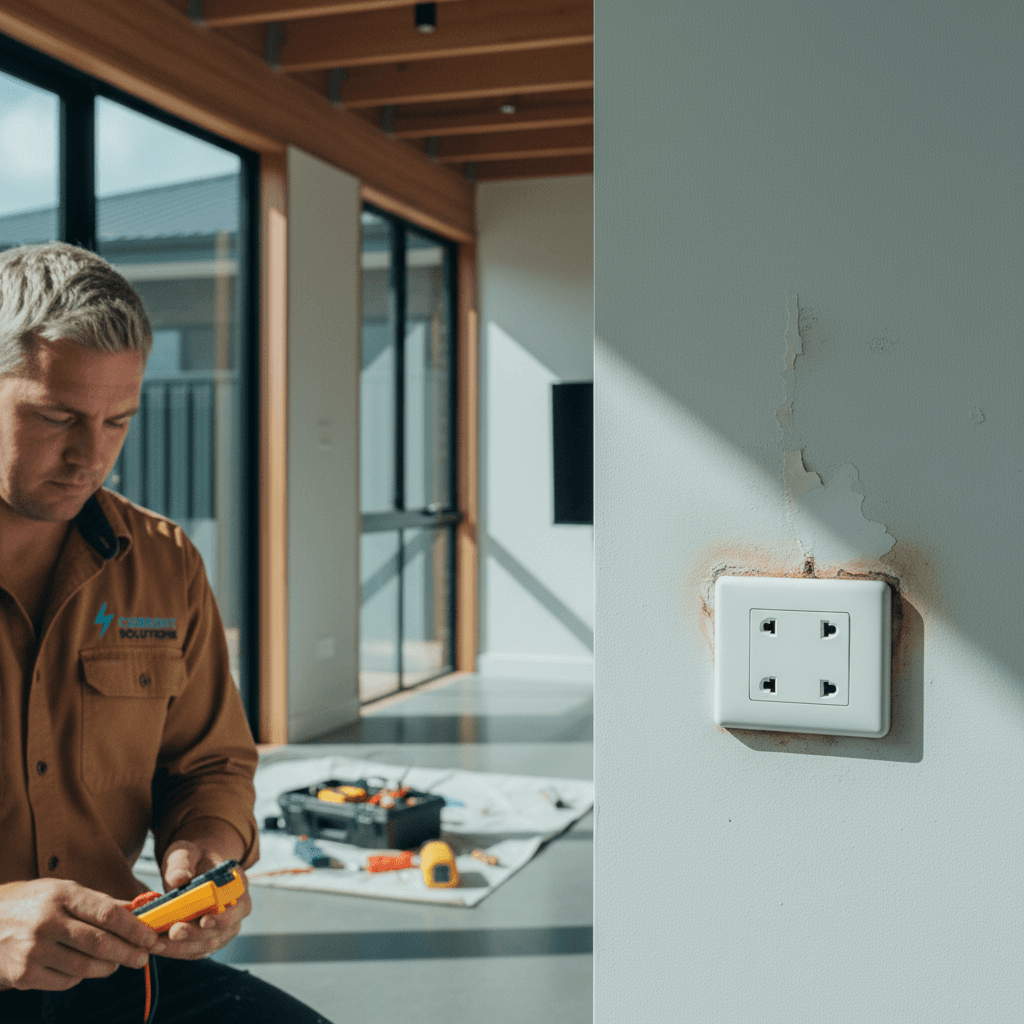
Water and electricity do not give you a second chance. I've been to jobs where a homeowner in Wynnum dried out a flooded socket with a fan and plugged a kettle back in an hour later, and the earth-leakage current was still high enough to trip the safety switch the moment it powered up. Water leaves residue. Residue conducts. And if you don't have a working safety switch on that circuit, the residue conducts through you.
The rule is simple: any powerpoint or socket that has had water inside it, from a roof leak, a burst pipe, a washing machine overflow, or a flood event, must be isolated at the switchboard and inspected by a sparky before anyone uses it again. Full stop.
Why water in a socket is a serious problem
A standard domestic powerpoint has live terminals sitting about 12mm behind those pin slots. Under normal conditions that gap is protected by air. Once water gets in, even a small amount of brackish or dirty water, that air gap becomes a partial conductor.
The immediate risk is electrocution if anyone plugs something in or touches wet pins. The secondary risk is tracking current, where moisture migrates inside the wall cavity along the cable insulation and causes intermittent faults days or weeks later. The third risk is corrosion: contacts that look fine to the eye but have a thin oxide layer that generates heat under load. Any one of those three can cause a fire.
Floodwater is never clean. It carries sediment, dissolved minerals and sometimes sewage, all of which reduce resistance and make the tracking problem worse. A socket that sat in 2022-style Brisbane floodwater for four hours is not recoverable with a hairdryer and good intentions.
The first thing to do (and it isn't grab a towel)
Here is the correct sequence, in order:
- Do not touch the socket, the plug, or anything plugged into it.
- Go to your switchboard and find the circuit that covers that area of the house. If you're not sure which one, switch off the main switch.
- Switch that circuit off.
- Put a piece of tape over the circuit breaker in the off position so nobody flips it back on by accident.
- Ring a licensed electrician. If it's a large-scale flood event or you're not sure how many outlets are affected, treat it as an emergency call.
That's it. You have now done everything a homeowner is legally allowed to do. The next steps require test equipment and a licence.
What you should not do: touch any plug, wipe the socket face with a cloth while power is still on, plug in a lamp to "test" whether it still works, or assume that because the circuit breaker hasn't tripped there's no problem. RCDs can fail to trip on slow current leakage, and older homes in Wynnum, Manly and Cleveland often have just one shared RCD for multiple circuits.
Why the hairdryer trick will make it worse
This one comes up more than you'd think. The logic is understandable: the problem is moisture, a hairdryer removes moisture, problem solved. Except that's not what happens.
A domestic socket has about 20 components: the moulded body, the face plate, the terminals, the earth bar, the wiring into the back-box. A hairdryer on the face of the socket drives warm air into the visible part, but it also pushes the moisture deeper into the back-box and into the wall cavity behind it.
The result: the face looks dry within a few minutes, the interior of the back-box is damp for another 48 hours, and the cable tail running back into the wall stays wet for days if the insulation has absorbed moisture.
The socket "works" when you plug something in, right up until the point when the terminal corrosion causes an arc at 2am that nobody notices until the smoke alarm goes off.
If the event was a roof leak directly above the socket, there is also a real chance that water tracked down the cable inside the wall and pooled at a connection point or in the switchboard. A hairdryer at the socket face does nothing about that.
When the socket needs replacing, not just drying
When I arrive at a water-damaged socket, the assessment goes like this:
- Visual check of the face plate and back-box. Discolouration, swelling, corrosion on terminals, any sign the plastic has been under load, and the whole outlet gets replaced.
- Insulation resistance test (IR test or "megger test") on the circuit cable. This measures whether the insulation on the conductors is still intact. A pass means the cable can stay; a fail means the run needs replacing.
- Check the switchboard. If the flood was significant, I'll pop the switchboard cover and check whether water tracked through to the busbars or terminals.
In my experience, any socket that has been submerged, even briefly, gets replaced as a matter of course. The cost is about $150-$220 for a single outlet including labour, test and certificate, and it removes any liability question.
Sockets that were only splashed or had a small drip run down the face are usually recoverable with a proper drying period (48-72 hours with the circuit isolated), followed by an IR test before re-energising. But that call has to be made by a sparky with a meter, not by a homeowner with a fan.
Insurance, what to document and who pays
SE QLD storm and flood events are insured events on most standard home and contents policies. The same applies to burst pipes, washing machine overflows, and roof leaks caused by storm damage. That means the cost of replacing storm-damaged sockets and cable is usually covered, but only if you document it properly.
Before anything is touched, do this:
- Photograph every affected socket, the water line on the wall, any damage to the wall itself.
- Photograph the circuit breaker in the off position.
- Note the date and time of the event.
When I attend a flood-related callout, I provide a written report that documents what was found, what was tested, what was replaced, and the cause of the damage. That report is what your insurer will ask for. Without it, they have no way to verify the damage was part of the insured event versus pre-existing.
One practical note: insurers in SE QLD are well across the storm season and process these claims regularly. A written sparky's report and a few photos is usually enough to get the claim moving. If you're in a suburb like Cleveland or Manly where tidal flooding is a known risk, your insurer may also want to know the flood height relative to the outlets, so measure it before anything dries out.
If you've had water near a socket after a leak or storm, ring 0411 054 811 and we'll get someone to you. We provide the written report for insurance and won't leave the site until the affected circuits have been tested and are either cleared or isolated.
, John
I'm John, local Camp Hill sparky, fully licensed, fixed-price quotes, lifetime workmanship warranty. Ring me direct on 0411 054 811 or send a quick message.
Keep reading
Storm damage and your home's wiring: a SE QLD safety guide
Brisbane storm season is brutal on home wiring. Here's what to check after a storm, and what to never, ever touch.
Burning smell from a powerpoint? Read this first.
A faint burning-plastic smell at a powerpoint is one of the most common pre-fire warnings in Brisbane homes. Here's what to do in the next 60 seconds.