
Sparks from a powerpoint when you plug something in? When it's normal vs when it's a fire risk
A small flash on plug-in is harmless arcing. Sustained sparks, a burning smell, or warmth around the socket isn't. Here's how to tell.
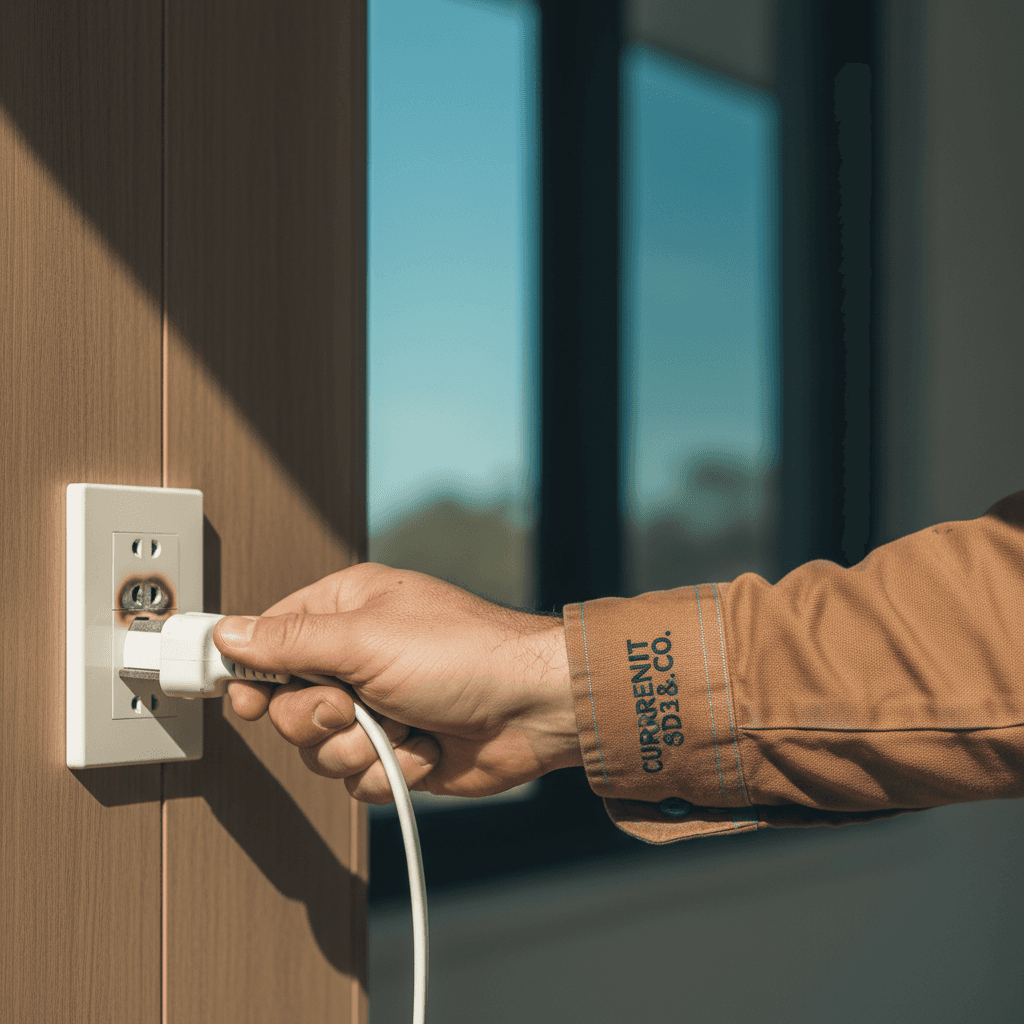
A small blue flash when you plug in the toaster is not a sign that your house is about to burn down. It is a completely normal physical phenomenon called inrush arcing, and it happens in every home, every day. The question is whether what you are seeing is that, or something else.
Here is how to tell the difference.
Normal spark vs dangerous spark: how to tell
Normal:
- A single small flash (usually blue-white) that lasts less than a tenth of a second as the plug makes contact.
- Only happens when plugging in devices with electric motors or compressors: fridges, air-conditioners, washing machines, pool pumps. These appliances draw a large in-rush current the moment the circuit closes, and that current briefly ionises the air in the gap between the pin and the contact spring.
- No smell. No repeat flashing after the plug is fully seated. No warmth around the socket.
If that is what you are experiencing, the socket is fine. The appliance is doing what physics requires it to do.
Not normal:
- A spark or flash that persists for more than a fraction of a second.
- Sparking when plugging in something that has no motor, such as a phone charger, a lamp, or a kettle.
- A crackling or hissing sound from the socket.
- A smell of burning plastic, even faint.
- The socket face is warm to touch.
- The plastic around the pin slots is discoloured, blackened, or melted.
- The socket produces a spark when you simply touch the plug to the face (before the pins make contact).
Any of those indicators means the socket has a problem and needs to be treated as a fault, not a quirk.
Make-safe steps if you're worried
If you are not sure whether what you saw was normal or not, err on the side of isolation:
- Unplug the device from the socket. Pull the plug body, not the cable.
- Go to the switchboard and switch off the circuit covering that area of the house. If labels are unclear, switch the main switch off.
- Do not use that socket again until a sparky has inspected it.
- Ring 0411 054 811 for a same-day assessment.
If the sparking was accompanied by a burning smell, read this post on burning smells from powerpoints for the faster make-safe sequence.
What actually causes sustained sparking
There are four root causes, each with a different repair:
Loose terminal. The screw clamping the active or neutral conductor inside the socket back-box has loosened over years of thermal cycling. When current flows, the loose connection causes micro-arcing at the terminal. This generates heat, which loosens the terminal further, which causes more arcing. Left alone, this is a reliable route to a wall fire. The fix is either a retighten (if the conductor and contact are in good condition) or a replacement socket.
Worn contact springs. The metal clips inside the socket that grip the plug pins have a finite life. In a socket that has been plugged and unplugged thousands of times over 20 years, the spring tension drops. A loose contact causes arcing every time current flows. You can feel this: a plug that feels loose in a socket, that "wiggles" slightly, is a socket with worn springs.
Excess load on a tired outlet. A double-adapter running a microwave, a kettle and a toaster, or a powerboard with a heater in it, overloads the socket. The contacts heat up, the plastic around them deforms slightly, and the connection quality drops. This is worse in older homes in suburbs like Wynnum and Carina where original 1970s sockets are still doing the work of a modern kitchen.
Cable damage behind the socket. Rodent damage, a builder's nail, water ingress, or VIR insulation decay can cause intermittent faults on the cable tail feeding the socket. This is the hardest one to diagnose from the face of the outlet and is the reason an IR test on the circuit is worthwhile when the cause is not obvious.
When I replace the outlet vs investigate further
On a sustained-sparking callout, I replace the socket as a matter of course regardless of what I find inside. The reason: once a socket has sustained arcing, the contact springs and the terminal surfaces have oxidised. A socket that "cleans up" when you retighten the screw will be back in the same position within a year.
The outlet replacement takes about 20 minutes. The question is what comes next:
- If the socket looks otherwise intact, the cable tail is in good condition, and the rest of the circuit is behaving normally, that is usually the end of it.
- If the socket interior has blackening, melted plastic, or signs of prolonged arcing, I will do a visual check of the switchboard terminals for that circuit and an IR test on the circuit cable. If the insulation resistance is low, there may be damage inside the wall that the socket replacement alone will not fix.
- If I find VIR cable (the black rubber cotton-sheath wiring used in Brisbane homes before the mid-1970s), I will show you and quote separately for that section. Arcing on a VIR circuit is a different level of urgency.
What the repair costs
A straightforward socket replacement, supply, install, test and certificate, runs $150-$220 for a single outlet in Brisbane in 2026. If the callout includes an IR test on the circuit, add $80-$120. If the cable tail needs replacing because it is damaged or VIR, add $180-$400 depending on the run length.
Most sparking-socket jobs are under $300 and resolved in a single visit. The cost of not fixing it is substantially higher: in property damage, in insurance complications, and in the potential for a more serious incident.
If you have seen sustained sparking from a socket, ring 0411 054 811. We cover Camp Hill, Carina, Wynnum and the surrounding suburbs same-day.
, John
I'm John, local Camp Hill sparky, fully licensed, fixed-price quotes, lifetime workmanship warranty. Ring me direct on 0411 054 811 or send a quick message.
Keep reading
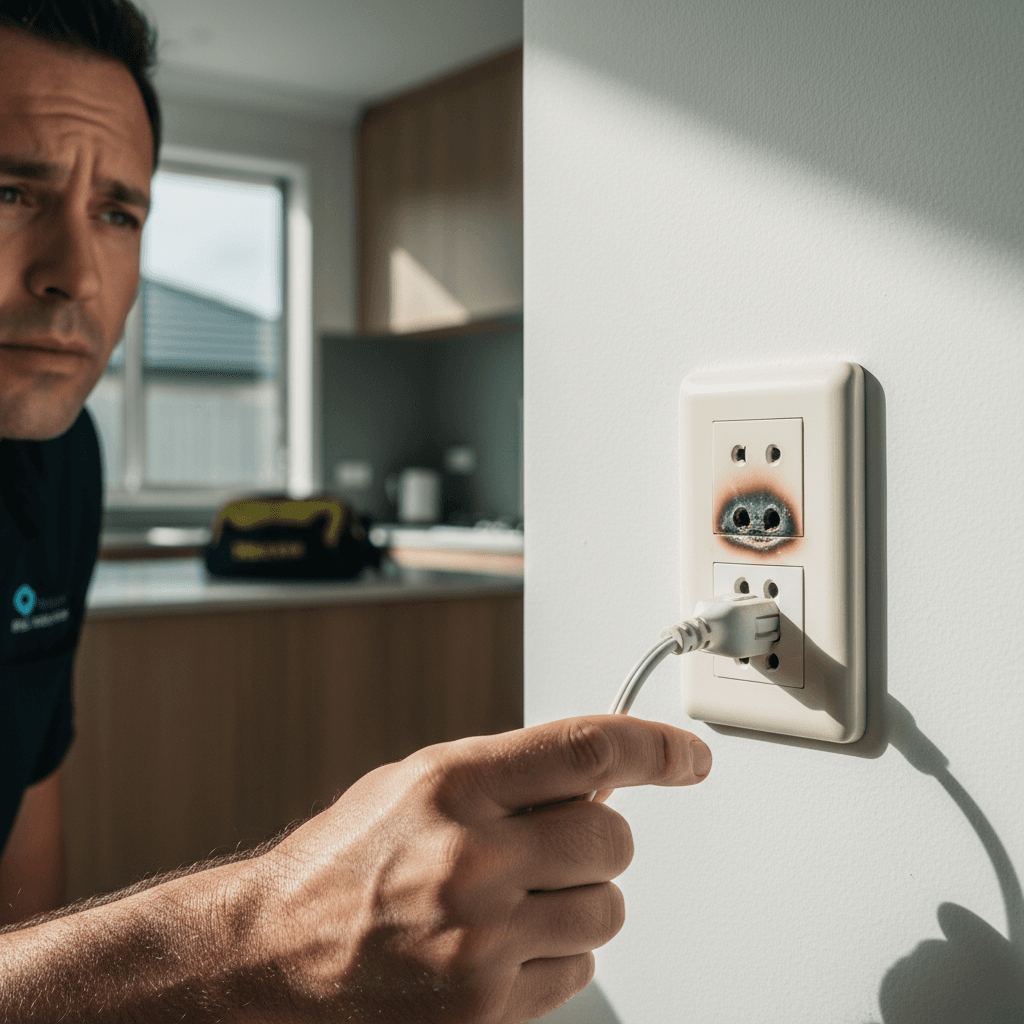
Burning smell from a powerpoint? Read this first.
A faint burning-plastic smell at a powerpoint is one of the most common pre-fire warnings in Brisbane homes. Here's what to do in the next 60 seconds.
What to do in an electrical emergency in SE QLD (the 60-second checklist)
Sparks, burning smell, total power loss, water hits the switchboard? Here's the exact 60-second checklist before you ring an emergency electrician.