
Wiring a shed or granny-flat-style outbuilding in QLD: the must-knows before you dig
Sub-mains, earthing, MEN, weatherproof boards: what the QLD wiring rules require for an outbuilding so it'll pass an electrical inspection.
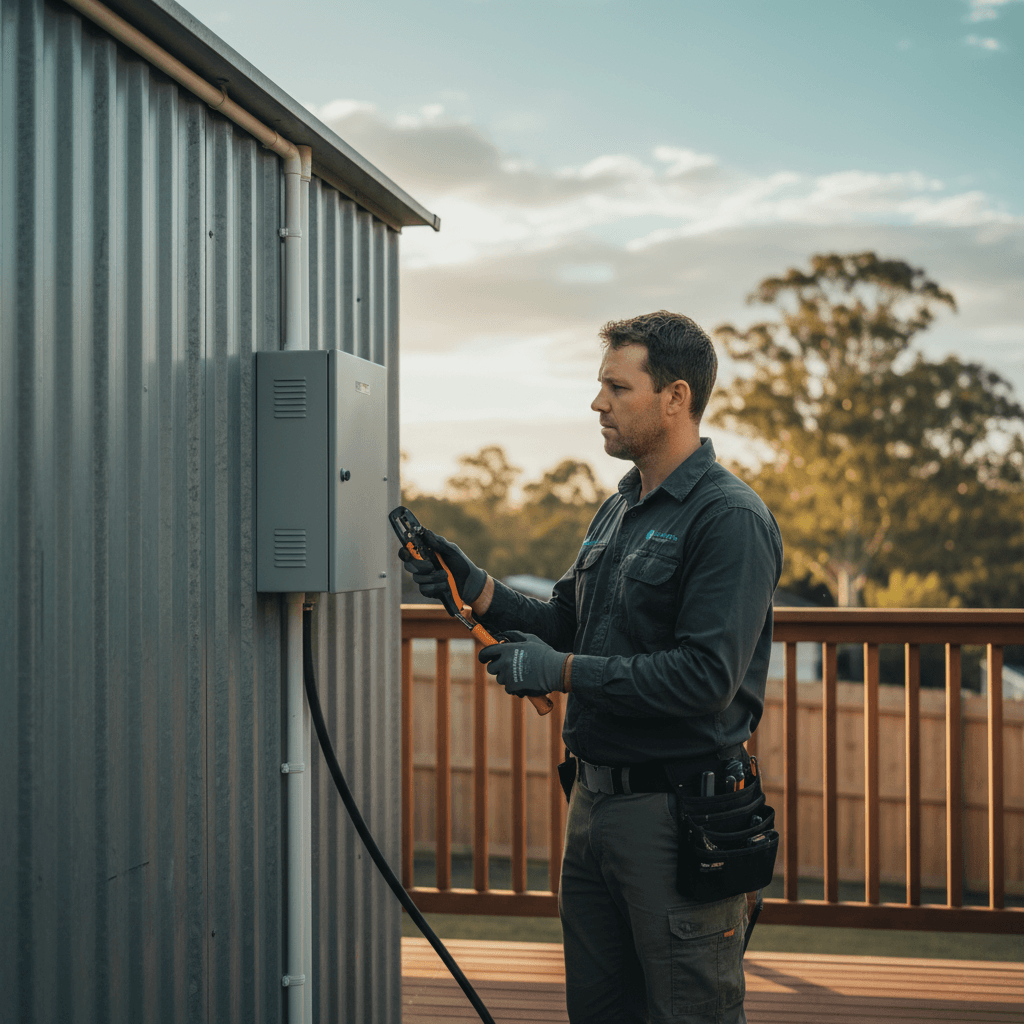
Shed wiring is one of those jobs where the homeowner often starts with a simple question ("can I just run an extension cord from the house?") and ends up with a much more involved conversation about sub-mains, earth stakes, and multiple earthed neutrals. The simple answer to the extension cord question is no, not permanently, not legally. Here is the complete picture.
I do outbuilding electrical installations across Belmont, Gumdale and Burbank regularly. These suburbs have a lot of larger residential blocks where sheds, workshops, and granny-flat-style structures are common, and the electrical requirements for these jobs are consistently more involved than most homeowners expect.
The sub-main: how power gets from the house to the shed
A sub-main is the cable run from the main switchboard in the house to the sub-board in the outbuilding. It is the electrical equivalent of the water main feeding a tap in the backyard. The sizing of the sub-main determines the maximum load the outbuilding can draw.
Cable selection:
The most common sub-main for a domestic outbuilding is Steel Wire Armoured (SWA) cable, run underground in a conduit or directly buried at the correct depth. SWA is chosen because:
- The steel armour layer provides mechanical protection against damage from digging and ground movement.
- It is rated for direct burial without additional conduit in many situations, though conduit inside the trench is best practice.
- It meets the AS/NZS 3000 requirements for underground wiring where mechanical damage is a risk.
An alternative is standard TPS cable run through conduit for the full length of the underground run, but SWA is generally preferred for outbuilding sub-mains because the armour provides an extra level of protection.
Trench depth:
Under AS/NZS 3000, cables installed underground must be at a depth that provides adequate protection from mechanical damage. For domestic installations, the standard depth for armoured cable is 500mm. For unarmoured cable in conduit, 600mm is typical. A layer of warning tape ("Danger, Electric Cable Below") should be laid above the conduit or cable in the trench, 150mm below the surface.
Conductor sizing:
The sub-main conductor size depends on the anticipated load, the cable length (longer runs require larger conductors to limit voltage drop), and any de-rating for installation conditions (cables in direct sun carry less current than cables in a cool conduit). A sparky will calculate the correct size as part of the design. For a typical workshop with lighting, power tools, and possibly a compressor, a 6mm or 10mm sub-main is common.
Earthing at the outbuilding
This is the part most homeowners do not expect. An outbuilding that is electrically separate from the main house structure requires its own earth electrode.
An earth electrode is typically a copper-clad steel rod driven into the ground at the outbuilding, with a connection to the sub-board's earthing terminal. The purpose is to provide a local earth reference for the sub-board and any equipment in the outbuilding.
The earth electrode at the outbuilding supplements the main earth at the house; it does not replace it. The earthing conductor from the sub-main also runs from the main switchboard to the sub-board, providing a continuous earth path back to the MEN point. The local earth electrode adds a local fault-current path and reduces the resistance of the earth system at the outbuilding.
In practice: the sparky installs a 1.8m copper earth stake at the outbuilding and connects it to the earthing bar in the sub-board. This is a mandatory step under the wiring rules and is not optional even if the main house has a perfectly functional earth system.
The sub-board and MEN link
Every outbuilding that is electrically classified as a separate installation requires its own sub-board, or "sub-distribution board." This is a small switchboard housed in a weatherproof enclosure at the outbuilding.
The sub-board must contain:
- A main switch (or the sub-main breaker at the house board effectively serves this function, but a local isolation point at the shed is best practice).
- RCBOs or RCDs for each circuit in the outbuilding.
- A busbar for the earthing terminals.
- A neutral link.
The question of the MEN (Multiple Earthed Neutral) link is technically nuanced and is one of the things a sparky must get right on this type of job. In a standard domestic installation, the MEN link connects the neutral and earth at the main switchboard. For a sub-board in an outbuilding, whether a separate MEN link is required depends on whether the outbuilding is classified as a separate installation or as an extension of the main installation. AS/NZS 3000 has specific criteria for this classification.
The practical implication: for most sheds and workshops that are a separate physical building, the sparky will install a MEN link at the sub-board. This is not something to improvise; getting the MEN arrangement wrong can cause dangerous voltage to appear on the earth conductor in fault conditions.
The sub-board enclosure must be weatherproof (IP rating appropriate to the location) and must be mounted so that it is accessible for operation and maintenance. In a shed or workshop, a surface-mounted weatherproof enclosure on the internal wall is the standard approach.
What circuits you need inside
Inside the outbuilding, the circuits are designed to match the intended use. Common configurations:
For a basic garden shed:
- 1 lighting circuit (LED lights on an RCBO).
- 1 general power circuit (2-4 double outlets on an RCBO).
For a workshop or tradie shed:
- 1 lighting circuit.
- 1 or 2 general power circuits for bench tools.
- 1 dedicated circuit for a compressor or fixed machinery (these have high start-up currents).
- 1 dedicated circuit for a dust extractor or other continuous-duty equipment.
- Optionally: a 3-phase circuit if 3-phase power is available and the equipment demands it.
For a granny-flat-style structure:
- Full domestic circuit load: lighting, power, hot water, kitchen, laundry, AC.
- The electrical scope is essentially a house, and the cost reflects that.
Every circuit in the sub-board must have its own RCBO. There is no situation where sharing a safety switch across multiple circuits in a new outbuilding installation is compliant with current practice.
Outdoor power outlets external to the outbuilding must also be on RCD-protected circuits and appropriate IP-rated outlets.
The inspection and certificate
All new electrical installations, including outbuilding sub-mains and sub-boards, require a Certificate of Test from the installing electrician. This certificate documents the work that was done, the test results (insulation resistance, RCD operating time, polarity, earth continuity), and certifies that the installation complies with the wiring rules.
In QLD, this certificate is issued by the licensed sparky, not by an independent inspector (except for larger installations that trigger a mandatory inspection under the Electrical Safety Regulation).
For council permit purposes: if the outbuilding required a building approval (most structures over 10m2 require a QBCC building approval), the electrical certificate may be required as part of the documentation at completion. Check with your local council and the builder about the documentation requirements for the specific structure.
The Certificate of Test is your proof that the installation was done correctly by a licensed person. Keep it. You will want it when you sell the property, and you may want it for insurance purposes.
What it costs
Outbuilding electrical costs in Brisbane in 2026 depend heavily on the distance between the house and the shed, the load requirements, and the complexity of the sub-board.
Typical ranges:
- Basic garden shed (sub-main to 15m, 1 lighting + 1 power circuit, weatherproof sub-board, earth stake, certificate): $1,800-$2,800.
- Workshop (sub-main to 20m, 1 lighting + 2 power + 1 compressor circuit, sub-board, earth stake, certificate): $2,500-$3,800.
- Long sub-main run (30m+, larger conductor for voltage drop, significant trenching): add $400-$900 to the above.
- 3-phase workshop supply (requires Energex application if not already 3-phase): add $1,200-$2,500 for the supply upgrade plus network fee.
These prices include the cable, conduit, sub-board, protection devices, earth stake, termination, testing and the certificate. They do not include excavation costs if a concrete slab or existing landscaping makes trenching difficult.
If you are planning an outbuilding in Belmont, Gumdale, Burbank or surrounding suburbs, ring 0411 054 811 before you dig. We will walk the job with you, give you a fixed-price quote, and make sure the electrical side is designed correctly from the start, not retrofitted around decisions that have already been made.
, John
I'm John, local Camp Hill sparky, fully licensed, fixed-price quotes, lifetime workmanship warranty. Ring me direct on 0411 054 811 or send a quick message.
Keep reading
Renovation electrical checklist for Brisbane homes (the one your builder won't give you)
What to think about *before* the walls go back up. The 12-point electrical checklist for Brisbane renovations, from powerpoint locations to data cabling.
DIY electrical work in QLD: what's legal, what's not, and what'll get you fined
QLD has some of Australia's strictest electrical-DIY laws. Here's what you can do as a homeowner, what you can't, and the actual penalties.