
Outdoor lighting installation guide for Brisbane homes: the full IP-rated layout
Festoon lights, downlights under eaves, garden spike lights, sensor floods: where they go, what IP rating they need, and the switching layout.
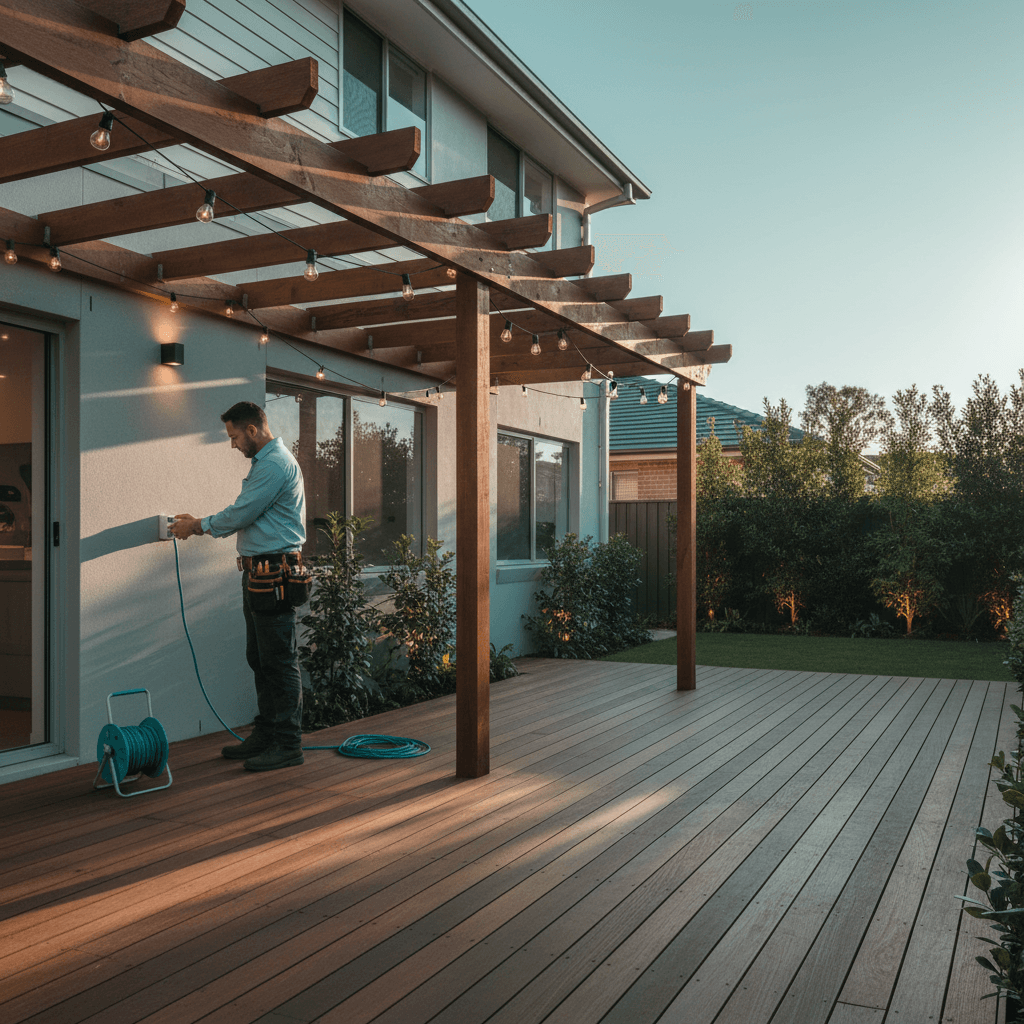
Outdoor lighting is one of those jobs that sounds simple until you start pulling permits. In Brisbane's subtropical climate, UV, humidity, monsoon rain and the occasional hailstorm mean the wrong fitting in the wrong location won't last two summers.
Here's the practical guide I run through with homeowners in Bulimba, Camp Hill and Carindale when they want to light up the backyard properly.
Planning your outdoor lighting zones
Before you pick a single fitting, divide the property into functional zones. This matters because different zones need different IP ratings, different circuits and different switching logic.
The four zones I typically plan around:
- Entry and front facade: Security-focused, sensor-activated, visible from the street. Soffits, wall-mounted up/down lights, sensor floods.
- Patio and entertaining area: Ambient and task. Festoon strings, downlights under the pergola or eaves, GPO for plug-in floor lamps.
- Garden paths and beds: Low-level orientation lighting. Spike lights or surface-mount path lights, usually 12V ELV (extra-low voltage) via a transformer.
- Perimeter and driveway: Wide-area coverage for access. Sensor flood lights, often 240V for output.
Drawing this out on a rough house plan takes ten minutes and saves two site visits. Do it before you ring me.
IP ratings for outdoor fittings
IP (Ingress Protection) ratings are the two-digit code on every fitting. The first digit is dust, the second is water. For Brisbane outdoor installs:
| Location | Minimum IP rating | Why | |----------|--------------------|-----| | Under covered eaves, no direct rain | IP44 | Protected from splashing | | Exposed pergola or open patio | IP65 | Dust-tight, jet-proof | | In-ground or submerged garden bed | IP67 | Temporary immersion | | Underwater (pond feature) | IP68 | Continuous submersion |
A common mistake is fitting an IP44 downlight under a wide eave, thinking it's fully protected. In a Brisbane thunderstorm, horizontal rain gets everywhere. I default to IP65 under eaves as standard and go to IP67 for anything garden-level. It costs $10-$20 more per fitting and saves a callback in six months.
Ratings below IP44 are not suitable for any outdoor location in SE QLD. If a fitting only shows "IP20" or "IP40", it's indoor only.
Fitting types and where they work
240V eave downlights: Same physical form as an indoor LED downlight but IP65 or IP66 rated. Goes into the soffit board, typically GU10 or integrated LED. Good for front entries and patio ceilings where you want bright, directed light.
Festoon strings: The string lights you see at every cafe and Airbnb in Brisbane. ELV (12V DC) festoon via an outdoor-rated plug-pack transformer is the safest and most flexible option: no licensed work required for the string itself (only the GPO and transformer circuit). 240V festoon strings also exist and are compliant when wired through a weatherproof GPO, but ELV is easier to reconfigure.
Garden spike lights: 12V DC via a transformer, usually with G4 or MR16 capsule globes. Low-maintenance when done with a quality transformer (Lumascape, VELT) but a headache when done with the $40 transformer from a hardware store that has no overload protection. The spike goes in the garden bed; the cable runs at 100-150mm depth in conduit or trunking.
Sensor flood lights: 240V, surface-mount to fascia or wall. Passive infrared (PIR) sensor with dusk-dawn photocell. These are the workhorses of suburban Brisbane security lighting. Fitting them too low (under 2.5m) gets you false triggers from cats; too high and the PIR arc misses the target zone. I aim for 2.5-3m, angled down about 30 degrees.
In-ground lights: IP67 or IP68, recessed into concrete or compacted gravel paths. These need a weatherproof junction box below grade and a proper cable termination. Not a job to scrimp on; a wet connection underground is a slow death for the fitting and a shock risk.
Switching and sensor layouts
Sensor and switching layout is where most homeowners leave performance on the table.
A well-designed outdoor lighting system has:
- Front entry: PIR sensor + dusk-dawn photocell on flood lights (auto only). Separate switch inside for entertaining occasions when you want them on all night.
- Patio: Manual switch at the back door, plus a dimmable circuit if you have dimmable LEDs under the pergola. A smart switch here (Clipsal Wiser or equivalent) is easy to add at rough-in stage.
- Garden and path lights: Typically on a timer relay or smart plug via the transformer, set to turn off at midnight. No point running them until 6am.
- Perimeter floods: PIR only. No manual switch needed; if they're on, something activated them.
Separate circuits for separate zones also means you can fault-find easily. If the patio lights go out, you know it's not the front entry circuit without walking the whole property.
Weatherproofing cables and connections
This is the part that determines whether the install lasts five years or twenty.
A few non-negotiables:
- All cable joints outside the building envelope must be in a weatherproof IP56 junction box. No gel-filled joiners buried in the soil. No taped joins behind the cladding. A proper IP56 box, mounted accessibly.
- UV-rated cable for exposed runs. Standard TPS degrades in UV within a few years. For any run that will see sunlight, use orange flexible UV-rated cable or run TPS inside UV-rated conduit.
- Conduit in the ground. Cable in garden beds should be in PVC conduit at a minimum of 300mm depth (under lawn) or 150mm under compacted gravel. This is both a physical protection requirement and a location requirement so the next person with a spade can find it.
- Conduit entry through walls sealed. Where conduit enters the house wall, seal the entry point with exterior sealant or a purpose-made cable gland to stop water tracking into the wall cavity.
I use direct-burial conduit underground, weather-rated boxes at every junction, and terminate all garden circuits back to a sub-board or weatherproof enclosure on the house wall. It takes longer to do properly the first time, but outdoor electrical work done badly is a nightmare to fault-find three years later when it's buried under a garden.
Cost guide per fitting and zone
2026 Brisbane installed pricing for outdoor lighting:
- 240V eave or soffit downlight (per fitting, including wiring): $110-$220
- Garden spike light (ELV, including transformer and cabling): $90-$160 per fitting
- PIR sensor flood light (240V, installed): $180-$280 per fitting
- Festoon string (ELV, GPO + transformer + 5-10m of string): $350-$550 supply and install
- Smart dusk-dawn switching relay (per zone): $160-$280
- Full backyard lighting package (3-4 zones, 6-8 fittings, proper conduit): $1,800-$3,500
The wide range on the full package reflects how different Brisbane properties are. A Bulimba post-war highset with timber framing and easy wall access is a quicker job than a brick veneer in Carindale with a concrete patio that needs trenching.
If you're planning an outdoor lighting upgrade in Bulimba, Carindale or Camp Hill, call 0411 054 811 and I'll come out for a free look and a fixed quote. I can usually do smaller outdoor jobs in a single visit.
, John
I'm John, local Camp Hill sparky, fully licensed, fixed-price quotes, lifetime workmanship warranty. Ring me direct on 0411 054 811 or send a quick message.
Keep reading
LED downlight upgrade guide: what to actually buy, and what it costs in Brisbane
What I install on every LED downlight upgrade in Brisbane, including the brands worth paying for, the dimmable trick most installers get wrong, and real prices.
Renovation electrical checklist for Brisbane homes (the one your builder won't give you)
What to think about *before* the walls go back up. The 12-point electrical checklist for Brisbane renovations, from powerpoint locations to data cabling.