
Main switch won't turn back on? The 5 things to check before ringing me
It's usually one of five things, four of which you can sort yourself in two minutes. The fifth needs a sparky and an Energex call.
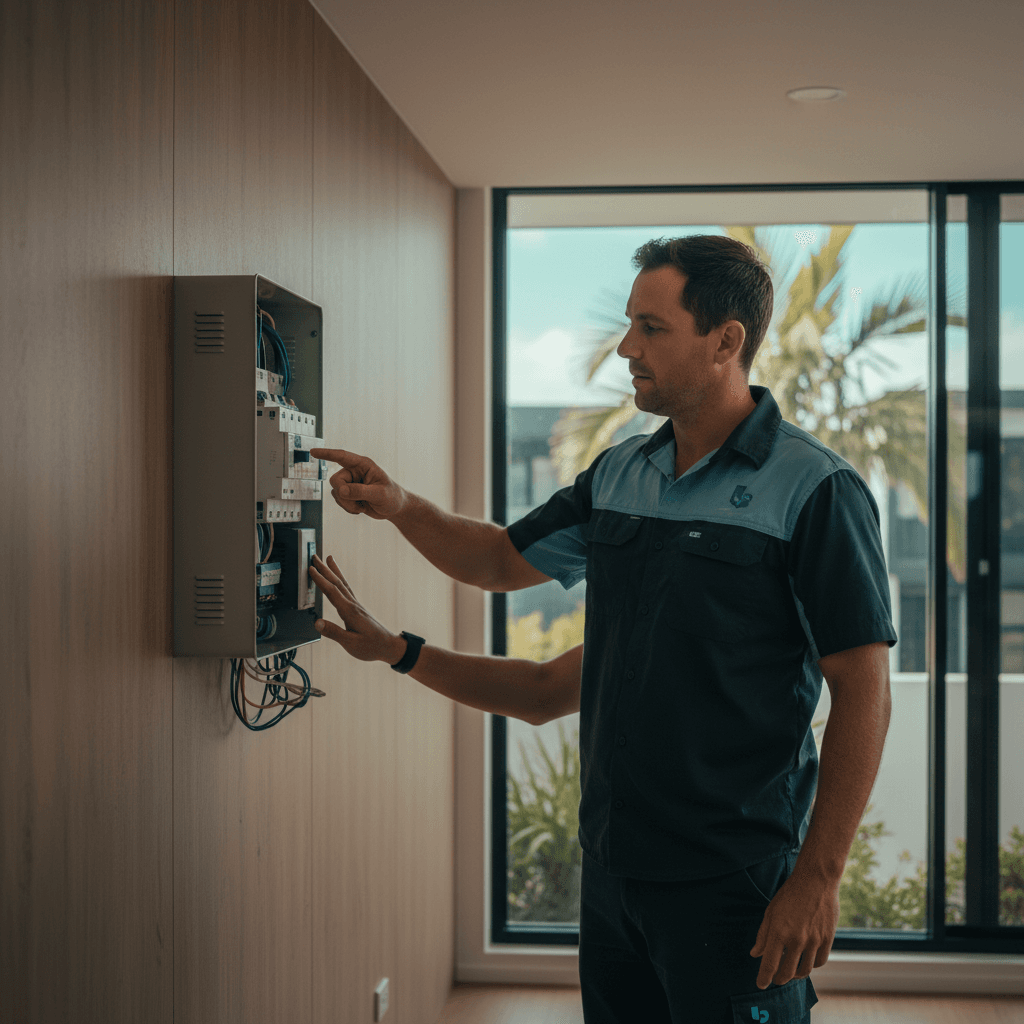
The main switch tripping is not something that happens often, and when it does, it gets people's attention. Unlike a single breaker going off, when the main switch goes, the entire house goes dark.
Before you ring me, here is the five-step diagnostic. Four of them you can work through yourself in under two minutes. The fifth is the one that needs a sparky and sometimes an Energex call.
Check 1: turn off all RCDs and MCBs first
This is the step most people skip, and it is the most important one.
Open the switchboard. Find every switch that is in the "on" position (pointing up, or to the right depending on the board orientation). Switch all of them off. Every RCBO, every shared RCD, every individual circuit breaker. Leave them all in the off position.
Now try the main switch.
If the main switch holds with everything else off, there is a fault on one of the downstream circuits, and you can isolate it using Check 2 below.
If the main switch trips again even with everything else off, skip to Check 3.
The reason for this step: a severe downstream fault (a short circuit, a heavy earth leakage) can hold the main switch in a faulted state. The main switch alone cannot clear that fault; it will just trip again. By removing the load from every circuit first, you give the main switch a chance to reset to a neutral state.
Check 2: identify the downstream fault
Assuming the main switch is now holding with all circuits off, here is how to find the faulty one:
- Turn the circuits back on one at a time, leaving a 5-10 second gap between each one.
- Watch the main switch. The moment it trips again, the circuit you just turned on is the source of the fault.
- Leave that circuit off and continue turning the others on. Confirm the remaining circuits all hold normally.
The faulty circuit is now isolated. Ring a sparky and describe which circuit it is (the label on the board, or a description of what it runs: "the kitchen power" or "the laundry").
Do not keep trying to reset the faulty circuit. If it tripped the main switch once, it will do it again, and repeated cycling of a faulted circuit is not good for the switchboard components.
Common causes at this point: a flooded outlet or fitting on that circuit, a failed appliance that has shorted to earth, or a damaged cable. A sparky can narrow it down with a megger test on the circuit before touching anything.
Check 3: is the problem upstream of the main switch?
If the main switch trips with all downstream circuits off, the problem is not in your house wiring. It is either:
- In the main switch itself (see Check 4), or
- In the supply side: the meter, the consumer mains cable (the cable from the meter to your board), or the Energex service connection.
To determine whether it is a supply issue, check whether your meter is displaying a reading. If you have a digital meter, is the display active? If you have a traditional spinning-disc meter, is the disc moving (or stopped with a backlight showing)?
If the meter display is blank or dead, the problem may be upstream of the meter, in the Energex network connection or the meter itself. Ring Energex on 13 19 62. They own everything from the street to (and including) the meter, and they will send a network technician. Do not attempt to access the meter box beyond reading the display.
Check 4: the main switch itself
If the meter is working, power is reaching the board, and the main switch still will not hold with all downstream circuits off, the main switch has an internal fault.
Main switches are electromechanical devices. After 20-30 years, the internal contacts can wear, the bimetal overload element can drift out of calibration, or the mechanism can jam in a partially tripped state. A main switch that trips immediately on reset with no load downstream is not doing its job and needs replacing.
Do not force the main switch lever. Forcing a mechanically faulted switch can damage the enclosure and in rare cases can cause the contacts to weld in the closed position, which is a more dangerous outcome than a trip.
Replacing a main switch is typically a 30-minute job for a sparky who has the right replacement switch in stock. Cost is roughly $180-$280 for the switch replacement alone, or it may be worth rolling it into a full switchboard upgrade if the board is already old.
Check 5: when to stop and ring
Stop the diagnostic and ring immediately if:
- You can smell burning plastic at or near the switchboard.
- The switchboard enclosure or the main switch is warm or hot to touch.
- There are visible scorch marks or discolouration on the switchboard or the meter box.
- The main switch makes a clicking, buzzing, or crackling sound when you try to reset it.
- You can see any blackening, melted plastic, or physical damage to any component in the board.
- You are not confident at any point in the diagnostic.
Any of those conditions means the board has had a significant fault event and needs a sparky before anyone uses the house power. In the meantime, leave the main switch off.
Voltech covers Camp Hill, Carina, Carindale and surrounding suburbs same-day. Ring 0411 054 811 with a description of what you found, and we will give you a call-out time on the spot. Most main-switch faults are diagnosed and resolved in a single visit.
, John
I'm John, local Camp Hill sparky, fully licensed, fixed-price quotes, lifetime workmanship warranty. Ring me direct on 0411 054 811 or send a quick message.
Keep reading
Why does my switchboard keep tripping? (Brisbane troubleshooting from a sparky)
The four common reasons a Brisbane switchboard trips, what each one means, and the order to investigate them in, without making it worse.
What to do in an electrical emergency in SE QLD (the 60-second checklist)
Sparks, burning smell, total power loss, water hits the switchboard? Here's the exact 60-second checklist before you ring an emergency electrician.