
Lightning hit near your home? The hidden electrical damage to check for
Direct strikes are rare but near-misses fry electronics. The 7 things to test in the 48 hours after a SE QLD storm, and what your insurer will want.
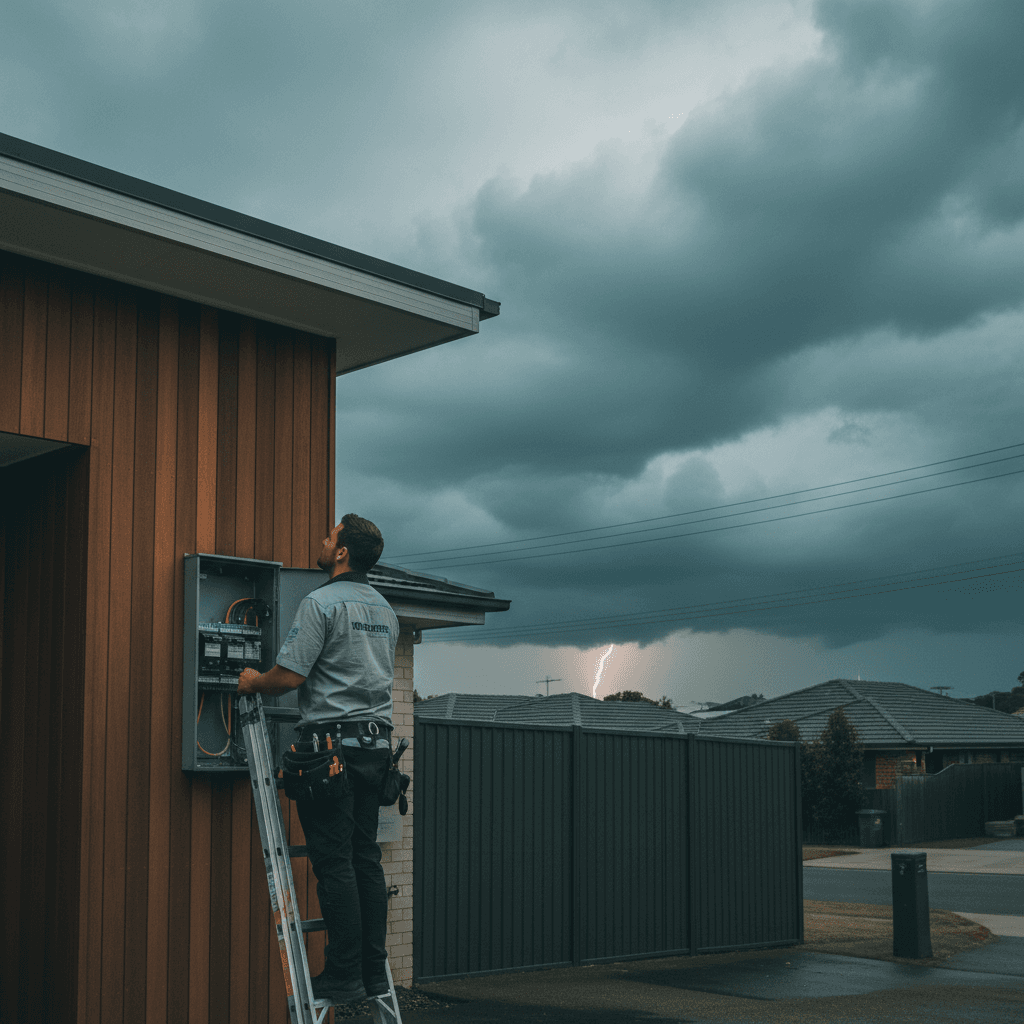
In SE QLD, lightning is not a once-a-decade event. It's a November-to-March fact of life, and in suburbs like Capalaba, Wynnum and Cleveland, which are on elevated ground or near water, the strike density is high enough that I get calls after most significant storms.
The good news is that direct strikes on a residential building are genuinely uncommon. The bad news is that a near-miss, a strike on a nearby tree, a neighbouring property, or on the Energex network itself, can cause a voltage surge that travels directly into your switchboard at thousands of volts and destroys electronics with no visible warning.
If you heard a loud crack nearby, lost power briefly, or came home to find appliances not working after a storm, here is the ordered list.
Near-miss vs direct strike: the difference matters
A direct strike on your house will usually cause visible structural damage: a blown roof tile, a split gutter, a scorched tree within 3m of the house. The electrical damage in a direct strike is catastrophic and usually includes melted cable insulation, blown SPDs, dead switchboard components, and failed appliances across multiple circuits.
A near-miss or induced surge is far more common and far more subtle. When lightning hits the street, the network transformer, or the ground nearby, it induces a voltage spike on the Energex supply lines. That spike travels down your service cable and through your meter into your switchboard. If you have a surge protection device (SPD), it clamps the spike and sacrifices itself. If you don't, the spike distributes across every circuit in the house and takes the weakest link with it.
The weakest link is almost always the electronics: your solar inverter, the PCB in your fridge, the modem, the garage door logic board, the AC control unit. These are all low-voltage electronics sitting on 240V circuits, and a multi-kilovolt transient destroys their internal components while leaving the power cable itself intact. The result is a device that looks fine but does not work.
The 7 things to check in the next 48 hours
Work through these in order:
- Solar inverter. Switch it off and back on. Does it start normally, connect to the grid and show production? A fried inverter will fault with an error code or simply not turn on. Inverter repairs average $400-$1,200; replacement runs $1,500-$3,500 for a residential unit.
- Modem and home network gear. A surge commonly enters through the telephone or NBN line as well as the power line. If your modem looks healthy but has no connection, and your ISP confirms the line is fine, the modem is dead. Check the router, the NBN connection device, and any switches.
- Fridge and freezer. The compressor motor is tough but the control PCB is not. If the fridge runs but the display is blank or behaving erratically, the control board has likely been affected. Check the temperature inside; if it's not cooling despite the compressor running, that's a diagnostic.
- Air-conditioning. The outdoor inverter PCB on a modern split system is the most expensive single component to replace after a surge. Try turning the unit on from the remote. If it doesn't respond, or throws an error code, note the code before calling the HVAC company.
- Garage door. Logic boards on automatic garage doors are surge victims in at least one in three lightning-damage jobs I attend. Test the remote, then test the wall button. If neither works but the motor unit has power, the board is gone. These are typically $250-$450 to replace.
- Smoke alarms. Hard-wired interconnected alarms have their own internal electronics. A surge can cause them to fault, chirp, or simply stop responding. Press the test button on each one after any significant storm.
- Switchboard SPD. See the next section.
What your surge protection device is telling you
A switchboard-mounted SPD has a status indicator, typically a small window with either a green cartridge visible, or a blank/red window indicating the cartridge has operated.
- Green window: the SPD is intact and ready.
- Blank or red window: the SPD cartridge has sacrificed itself to absorb a surge. Good news, it means the SPD worked. Replace the cartridge (typically $80-$150 at Voltech) before the next storm season.
- No window or status indicator: older SPDs or base-level models may not have a visible status. If you're unsure whether your SPD is still functional after a storm, a sparky can test it with a meter.
If you don't have an SPD at your switchboard and you're in SE QLD, fitting one is the single highest-value thing you can add to your electrical installation. A Type 2 SPD fitted at the switchboard costs roughly $350-$550 including installation and does the job that a power board surge protector only pretends to do.
Insurance: what you need before you make a claim
Lightning and storm surge are generally covered under home and contents policies, but the claims process has some specifics worth knowing:
- Document everything before replacing. Take photos of dead appliances, error codes on screens, and the switchboard SPD status window.
- Get a sparky's report on the electrical damage. Your insurer will want evidence that the failure was caused by a surge event, not a pre-existing fault. A licensed electrician's written report documenting what was tested, what failed, and the likely cause is the piece of paper that makes a claim go smoothly.
- List appliance model and purchase date. Most policies have a per-item limit and some have depreciation schedules. Having the documentation makes the process faster.
- Claim the SPD replacement too. If the SPD operated during the storm, the cartridge replacement is typically claimable as part of the storm damage.
What I do when I attend a lightning callout
A lightning-damage assessment with Voltech typically covers:
- Visual inspection of the switchboard and SPD status.
- Insulation resistance test on any circuit showing erratic behaviour.
- Functional check of RCDs and main switch.
- Check of all hard-wired smoke alarms.
- Review of visible appliance status with the homeowner.
- Written report documenting findings, with photos, for insurance.
The callout takes 45-90 minutes depending on the size of the house and the number of affected items. We provide the insurance report at the end of the visit, and if further work is needed (circuit repair, SPD cartridge, smoke alarm replacement), we quote it on the spot.
Prevention: what actually works
If you're in SE QLD and you don't yet have a Type 2 SPD at the switchboard, fitting one before next November is the most cost-effective thing you can do. It will not prevent lightning from striking nearby. It will, however, prevent the resulting voltage transient from destroying your fridge, your inverter, and your $3,000 ducted AC control unit.
A few other things that help:
- Unplug appliances during a storm if you can see it approaching. This is old advice and it still works. A surge can't fry a TV that's not plugged in.
- Power board surge protectors provide a small amount of protection at the socket but are not a substitute for a switchboard SPD. The energy of a mains-level surge will overwhelm most power board protectors before they can protect anything.
- NBN and telephone line protection. A significant portion of surge damage enters through the phone or data line, not the power. If your modem is on the exposed end of an outdoor NBN connection, it is more exposed than most.
If you've had a storm and you're finding dead electronics around the house, ring 0411 054 811. We'll assess the electrical side, document it for insurance, and give you a straight answer on what needs replacing and what can wait.
, John
I'm John, local Camp Hill sparky, fully licensed, fixed-price quotes, lifetime workmanship warranty. Ring me direct on 0411 054 811 or send a quick message.
Keep reading
Storm damage and your home's wiring: a SE QLD safety guide
Brisbane storm season is brutal on home wiring. Here's what to check after a storm, and what to never, ever touch.
Why is the power flickering in my Brisbane home?
Lights flickering when nothing's wrong with the storm? Here's what flickering actually means, and the four causes I see most often.