
Granny flat electrical compliance in QLD: the must-knows for an auxiliary dwelling
Sub-mains, smoke alarms, RCDs, separate metering: the electrical rules for a granny flat or auxiliary dwelling under QLD planning + ESA law.
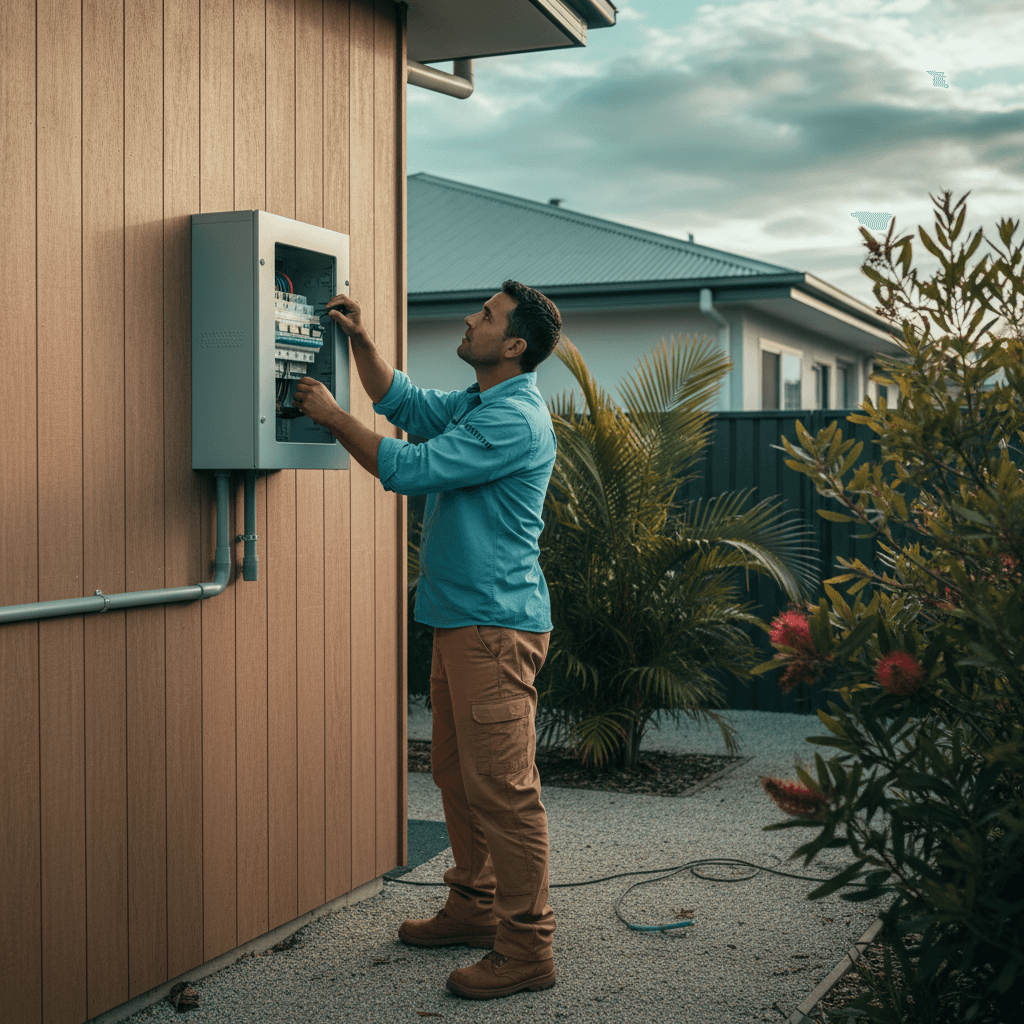
Granny flats are one of the most common project types I see in the inner east and inner south Brisbane suburbs at the moment. Bulimba, Camp Hill, Norman Park, all have homeowners trying to make the most of larger blocks by building or converting an auxiliary dwelling. The electrical scope for a granny flat is more involved than most people expect, and getting it wrong creates compliance problems that affect the property's insurance, tenancy, and sale value.
Here's what the electrical rules actually require for a granny flat under Queensland law.
The sub-main from the main board
A granny flat is a separate dwelling, and that means it needs a separate electrical supply, not just a cable run from the nearest powerpoint in the main house.
The correct arrangement is a sub-main: a dedicated cable run from the main switchboard to a separate consumer switchboard (sub-board) inside the granny flat. The sub-main must be:
- Sized for the total expected load of the flat (typically 63A single phase for a small flat, more if there's electric cooking and air conditioning).
- Protected at the main switchboard by a circuit breaker rated to the sub-main cable capacity.
- Run in conduit underground (if crossing the yard) or overhead (with clearance requirements), depending on the site layout.
- Earthed correctly: the sub-board has its own earth electrode or is earthed back via the sub-main earth conductor.
The sub-main is what gives the granny flat independent electrical isolation. When the tenant trips a safety switch, it affects only their flat, not the main house.
Separate metering: when it's required
Whether the granny flat gets its own Energex meter or shares the main meter depends on the planning approval and the arrangement between the owner and tenant.
If the flat is being rented independently: a separate meter is strongly recommended and may be required by the tenancy agreement. Without one, the tenant and the main occupant are sharing a single power bill, which is legally messy. The tenant cannot be charged for power they can't individually control.
Separate metering process: To get a separate meter installed, you need to apply through Energex (via a licensed electrician acting as the customer's agent). This requires a service entrance from the street, a separate meter board, and a separate sub-main. Energex's network charges for the new connection apply, typically in the range of $2,000-$4,500 depending on the existing infrastructure.
If the flat is for family: sharing the main meter is permissible and simpler, but you still need a proper sub-main and sub-board for safety isolation.
The sub-board inside the flat
The sub-board in the granny flat is a scaled-down version of a main switchboard. Under the wiring rules, it must include:
- A main isolating switch for the flat (allows the whole flat to be isolated independently).
- A Multiple Earthed Neutral (MEN) link: this is an important point. The sub-board must have correct earthing arrangements per the wiring rules. An electrician unfamiliar with sub-board earthing requirements sometimes gets this wrong.
- Individual circuit breakers (or RCBOs) for each circuit: power, lighting, kitchen appliances, air conditioning, hot water.
- RCD protection on every circuit. This is mandatory, not optional.
For a typical 2-bedroom granny flat, the sub-board will have 6-10 circuits. For a studio or 1-bedroom flat, 4-6 circuits. Each circuit needs its own RCD protection, which in 2026 typically means individual RCBOs rather than a bank RCD arrangement.
Smoke alarm requirements
This catches a lot of people. The QLD smoke alarm laws apply to granny flats in exactly the same way as they apply to the main dwelling. There is no exemption for small auxiliary dwellings.
Required under QLD smoke alarm laws:
- Photoelectric smoke alarms only (not ionisation).
- Interconnected: all alarms in the flat go off together.
- Hard-wired 240V (with battery backup), or 10-year lithium sealed battery alarms.
- One in every bedroom of the flat.
- One in every hallway connecting bedrooms to the rest of the flat.
- One on every storey if the flat has more than one level.
If the flat is being built new: hard-wired alarms are required. If it's a conversion of an existing space: the hard-wired requirement applies from 1 January 2022 for any dwelling being leased. The 10-year sealed battery option is an alternative only for dwellings not yet required to be hard-wired.
The interconnection must cover only the flat. The flat's smoke alarms do not need to be interconnected with the main house's alarms (though some owners choose to do this for security reasons).
RCDs on every circuit
This is worth its own section because it's so often skimped on.
The wiring rules require RCD protection on all circuits in a domestic installation. In a granny flat, that means every circuit in the sub-board. Every power circuit, every lighting circuit, every fixed appliance circuit.
The practical consequence is that in 2026, a properly compliant granny flat sub-board has individual RCBOs on every circuit, not a single bank RCD covering all circuits. The single bank RCD approach (where one fault trips the whole flat) doesn't meet the current standard and is genuinely annoying for tenants.
Occasionally I see granny flat sub-boards that were installed cheaply with a single 30mA RCD and a row of MCBs. That's not compliant for new work in 2026.
What it costs in Brisbane 2026
Electrical scope for a granny flat varies with size and starting point. Rough ranges from jobs in Bulimba, Camp Hill, and Norman Park:
- Sub-main only (shared meter, existing main board has capacity): $1,800-$3,200 depending on run length and conduit requirements.
- Sub-board and wiring for a studio or 1-bedroom flat (fit-out electrical): $3,500-$5,500.
- Sub-board and wiring for a 2-bedroom flat: $4,500-$7,500.
- Smoke alarms (hardwired, interconnected, 2-3 alarms): $350-$550 added to the above.
- Main switchboard upgrade if the main board is full or too old to safely add a sub-main: $1,650-$2,400.
- Separate Energex metering (if required): $2,000-$4,500 in network connection fees, plus electrical on our end for the meter board wiring.
Total for a typical 1-bedroom granny flat on a Camp Hill property with shared meter: $5,000-$8,500 for the full electrical scope including the renovation electrical checklist items.
Timing note: The electrical rough-in for a new granny flat build should happen at the same time as the structural frame goes up, before any internal lining is installed. Trying to add electrical after the walls are lined is the same as doing it in a renovation: expensive fish jobs instead of cheap open-frame cable runs. Get the sparky engaged before the builder starts, not after the slab is poured.
What council will ask about: Brisbane City Council's development approval for an auxiliary dwelling does not specifically require an electrical inspection, but the building certifier issuing the final certificate of occupancy needs to be satisfied that all required inspections have been passed. For an electrically serviced dwelling, the certificate of electrical safety is part of that package. If you're building without planning approval (some small ancillary structures qualify as exempt), you're still fully subject to the Electrical Safety Act requirements for any electrical installation in the structure.
Ring me on 0411 054 811 if you're planning a granny flat and want a proper scope of works and quote before you go to the builder.
, John
I'm John, local Camp Hill sparky, fully licensed, fixed-price quotes, lifetime workmanship warranty. Ring me direct on 0411 054 811 or send a quick message.
Keep reading
Renovation electrical checklist for Brisbane homes (the one your builder won't give you)
What to think about *before* the walls go back up. The 12-point electrical checklist for Brisbane renovations, from powerpoint locations to data cabling.
QLD smoke alarm laws 2027: the simple version (and what it'll cost)
From 1 January 2027, every QLD home needs interconnected, photoelectric, hard-wired smoke alarms. Here's exactly what you need, where, and what it should cost.