
Electrician hourly rate in Brisbane (2026): what you actually pay vs what gets quoted
Hourly rates of $90-$165 are advertised but no decent sparky charges hourly for jobs over an hour. Here's the real cost structure.
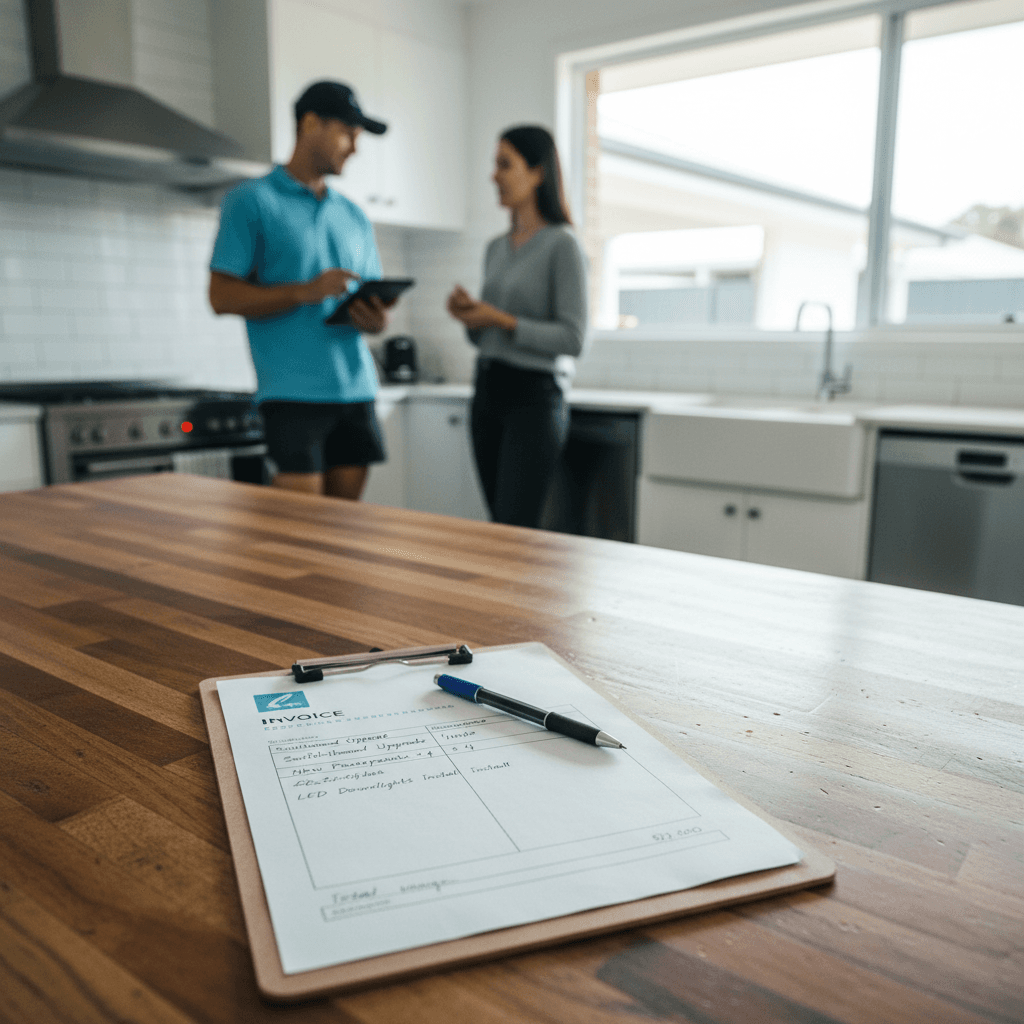
The "hourly rate" question is one I get often, and the honest answer is that the advertised hourly rate tells you almost nothing useful about what you'll actually pay for a job. Here's why, and what the real numbers look like in Brisbane in 2026.
Most decent Brisbane sparkies don't actually charge hourly for jobs over about 30 minutes. They walk in, look at the job, and give you a fixed price. The hourly rate exists as a backstop for unusual jobs where scope genuinely can't be determined in advance - fault-finding in complex systems, for example - but for the vast majority of residential electrical work, you'll get a fixed price within 5 minutes of the sparky seeing the job.
The advertised hourly rate
When sparkies advertise hourly rates in Brisbane in 2026, you'll typically see:
- First hour (includes call-out): $130-$185
- Additional hours: $90-$140 per hour
- After-hours first hour: $165-$250
- After-hours additional: $120-$165 per hour
These are the posted rates. They apply when hourly billing is used. But here's the thing: a sparky who is charging you purely hourly for an electrical renovation or switchboard upgrade is either not very efficient or not very confident in their own pricing. Good sparkies know how long things take and price accordingly.
Why hourly billing doesn't work in practice
Hourly billing puts all the risk on the client. If the job takes longer than expected - and in electrical work, especially in old Brisbane homes, it often does - you pay the overrun.
It also creates a perverse incentive: the slower the sparky, the more they earn per job. This is not how you want to be paying someone.
From the sparky's side, hourly billing is actually harder to manage. Every 15 minutes spent tracking time is 15 minutes not working. A fixed price means both parties know the number up front, the job gets done as efficiently as possible, and there are no awkward conversations at the end.
For fault-finding specifically, hourly is sometimes unavoidable. Tracking down an intermittent fault in a 1950s Queenslander wiring system takes however long it takes. In that case, a good sparky will quote the fault-finding at an hourly rate (usually with a maximum cap) and then give you a fixed price for the repair once the fault is identified.
Fixed-price quoting: how it actually works
A fixed price comes from the sparky's experience with similar jobs. A switchboard upgrade to a 3-bed home with a specific board configuration: they've done 50 of them, they know it takes 4-6 hours, they price accordingly. A like-for-like powerpoint replacement: 20 minutes, fixed at $99-$130.
The fixed price covers:
- Labour (based on estimated time)
- Materials (cables, fittings, hardware - sometimes itemised, sometimes bundled)
- Vehicle, tools, insurance, GST
It does not typically cover:
- Unexpected discoveries (finding VIR cabling where there should be modern cable, finding no earthing, finding a previous unlicensed job that needs rectification)
- Additional scope added during the job ("while you're here, can you also...")
A good sparky will tell you about scope changes before doing the additional work, not after. "I've found X which needs to be addressed - here's what that adds to the price" before they continue is professional. Finding it on the invoice is not.
Real 2026 Brisbane rates by job type
Rather than hourly rates, here are typical fixed prices for common jobs in Brisbane in 2026:
| Job | Typical price | |-----|--------------| | Like-for-like powerpoint replacement | $99-$130 | | New powerpoint (fish through wall) | $180-$280 | | LED downlight swap (per light) | $30-$60 labour + hardware | | Ceiling fan installation (existing wiring) | $120-$180 | | Safety switch installation (per RCD) | $180-$280 | | Switchboard upgrade (3-bed home) | $2,200-$3,800 | | Smoke alarm installation (per alarm, inc hardware) | $220-$350 | | Full 3-bed home rewire | $10,000-$18,000 |
These are real 2026 numbers, not inflated. They include GST, materials (for most items), and assume normal access. Difficult access, heritage homes, or coastal areas with higher material costs may push the top end.
Apprentice vs licensed sparky rates
An apprentice electrician can work on jobs, but must be supervised by a licensed electrician. Supervision does not mean the licensed sparky is watching every move - an apprentice can work independently within sight of the licensed worker, or on simpler tasks with periodic checking.
Some larger companies send an apprentice to residential jobs and quote a lower rate. This is legal and often fine for simple work. For complex or high-risk jobs (switchboard work, fault-finding, renovation wiring), you want a licensed electrician, not a first-year apprentice on day rate.
What to ask: "Will it be a licensed electrician on site, or an apprentice?" If it's an apprentice, "will the licensed worker be on site or nearby?"
An apprentice in years 1-2 earns around $14-$20/hr under the award. The firm still charges full rates. There's nothing wrong with this as a business model - it's how tradies are trained - but you should know who is at your house.
What you can't do with an apprentice alone: an apprentice cannot sign off on electrical work. Only a licensed electrician can issue a Form 16 (Certificate of Test). So even if the apprentice does all the hands-on work, a licensed sparky must inspect, test, and certify before leaving. On a well-run job this happens naturally. On a poorly managed one, the apprentice leaves and the Form 16 never arrives. Ask for the certificate before they go.
What Voltech charges and why
I charge fixed price for everything I can scope in advance. My hourly rate is $130 (business hours) if we genuinely can't scope it - fault-finding work mostly. After-hours is $165/hr.
For standard jobs, you get a written fixed-price quote before I touch anything. There are no time-tracking surprises and no billing for the 20 minutes I spent in the roof cavity working out the circuit layout.
I'm a one-man operation: no apprentices dispatched solo, no subcontractors. John does the job. That's the model. The person who gives you the quote is the person who does the work and issues the certificate.
A note on travel: I work primarily across Camp Hill, Carina, Coorparoo, Carindale, and surrounds. For jobs within that area, I don't add travel surcharges. If you're in Wakerley, Wynnum, or Norman Park - still comfortably within my regular run - same deal. I'll flag it if you're genuinely far out.
What does GST look like on a typical invoice?
On a $250 job, GST adds $25. So a job quoted at $250 + GST becomes $275 on the invoice. Some sparkies quote inclusive, some exclusive. Ask "is that price including GST?" before you compare quotes from different operators. My quotes are always GST-inclusive.
The other line item to understand is materials. For replacement powerpoints, safety switches, circuit breakers - the parts are almost always included in the fixed price. For larger orders (cable for a rewire, multiple smoke alarms, switchboard hardware), I itemise them separately so you can see exactly what you're paying for hardware vs labour.
See the call-out fee guide for after-hours pricing in detail. Ring 0411 054 811 to discuss your job.
, John
I'm John, local Camp Hill sparky, fully licensed, fixed-price quotes, lifetime workmanship warranty. Ring me direct on 0411 054 811 or send a quick message.
Keep reading
Average electrician call-out fee in Brisbane (2026): what you should and shouldn't pay
$0 to $250 in 2026 Brisbane, depending on time of day, suburb, and whether the sparky's any good. The honest pricing breakdown.
Hiring a local electrician in Camp Hill: what to ask before you book
The 9-question filter for hiring a local sparky in Camp Hill or anywhere in south-east Brisbane. Avoids the most common bad hires.