
Ducted air conditioning electrical requirements in Brisbane (and why your switchboard probably can't handle it)
Most ducted systems pull 16-32A. The dedicated circuit, the load calc, and the switchboard upgrade that 90% of Brisbane retrofits need.
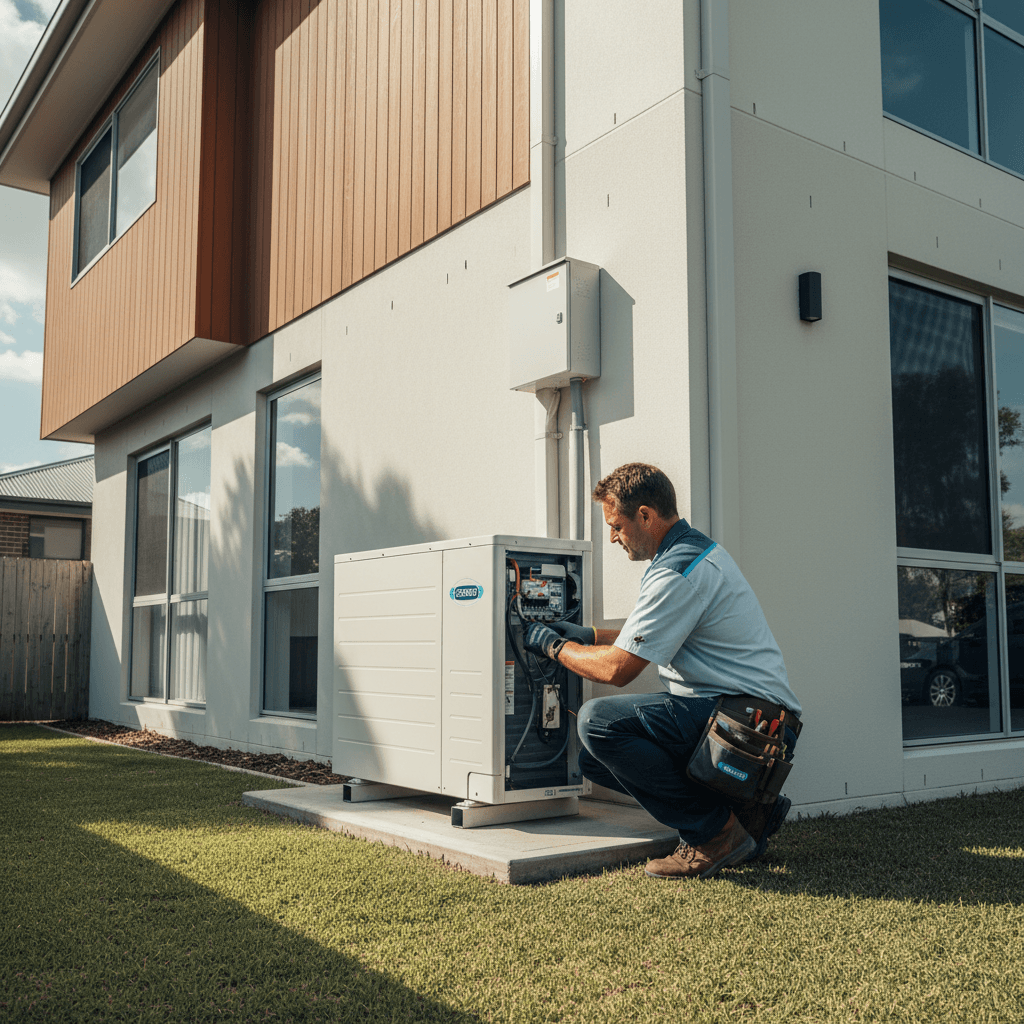
If you're getting a ducted air conditioning system put into a Brisbane home built before 2005, there's a reasonable chance the electrical side of the job is bigger than the AC installer quoted you. Not because anyone is pulling a swiftie, but because the AC industry and the electrical industry don't always talk to each other before the compressor arrives.
Here's what the electrical side actually involves, from someone who wires up a handful of ducted systems every year across Carindale, Wakerley, Mansfield and the surrounding suburbs.
How much power a ducted system actually draws
The figures on the brochure are the "rated" figures at steady-state operation. Real-world draw is different.
A typical residential ducted system in the 10-16kW cooling range draws:
- Start-up (inrush): 60-80A for 2-3 cycles, which is why the wrong breaker will trip every morning.
- Steady-state running: 16-28A, depending on outdoor temperature and house insulation.
- Large systems (18-22kW+): Can hit 32A steady-state, which is a 32A rated circuit running close to its limit. Not ideal.
The AC installer will give you a minimum circuit rating from the manufacturer's spec sheet. Trust that number, but understand it's the minimum, not necessarily what I'd fit.
The dedicated circuit requirement
Under the wiring rules (AS/NZS 3000), a ducted air conditioning system must be on its own dedicated circuit. It cannot share a circuit with other fixed appliances.
What that dedicated circuit looks like:
- Rating: Typically 20A or 32A, depending on the system spec.
- Cable: Usually 4mm² or 6mm² TPS, depending on the run length and the ampacity required. Longer runs need heavier cable to keep voltage drop within limits.
- Protection: An RCBO (combined circuit breaker and RCD) at the switchboard. The 30mA RCD is mandatory under AS/NZS 3000 for all final circuits.
- Run: From the switchboard, usually through the roof cavity, down the wall to the external compressor location.
The condenser unit outside also needs an isolator, which I'll cover in the next section.
What I often find when I get called to a retrofit job is an AC installer who's quoted to run the lineset and duct but has left the circuit as "client to arrange electrician." That's fine, just make sure you've arranged the sparky before the AC crew turn up, because nothing is more annoying than a fully installed system with nowhere to plug it in.
The isolator rule (and where it goes)
This one catches people out. The wiring rules require an isolating device (a dedicated switch) within sight of the compressor unit and accessible without tools. The purpose is so any technician servicing the outdoor unit can safely isolate power without walking back inside to the switchboard.
For most Brisbane jobs this means:
- A weatherproof IP56 rotary isolator, mounted on the wall adjacent to the compressor slab, usually within 1.5 metres.
- Rated to the circuit (typically 32A) and compliant for outdoor exposure.
- Fixed to brick, concrete block or a purpose-made isolator bracket on the fence or wall. Do not mount it on the AC unit itself; it needs to remain accessible if the unit is replaced.
Some installers assume the AC unit has a built-in isolator switch on the side panel. Some do, but these are not always compliant under the wiring rules depending on how they're rated and configured. I fit an external isolator as standard and avoid the argument on the inspection.
Why most Brisbane switchboards can't handle it
This is the part nobody warns you about when you accept the AC quote.
A typical Brisbane home built in the 1980s or 1990s has a switchboard with six to eight circuits total, including one shared RCD covering all of them. Adding a 32A ducted AC circuit means:
- No spare pole positions. There's literally no room in the enclosure for another RCBO.
- Undersized consumer mains. If the main cable from the meter to the board is old 10mm² or smaller, adding a 32A load pushes the total possible draw beyond what that cable was rated for.
- No individual RCD on the AC circuit. If your board uses a shared RCD arrangement, the AC circuit might not have its own protection, which the current wiring rules require for new work.
- Insufficient enclosure rating. Some older boards are rated for their original configuration; adding circuits without upgrading the enclosure can be non-compliant.
In my experience, about 90% of ducted AC retrofits into pre-2000 Brisbane homes need at least a partial switchboard upgrade: new enclosure with room to grow, RCBOs per circuit, and consumer mains checked. That's not the AC installer's fault; it's just what happens when you add 30 years of technology to a 30-year-old board.
A switchboard upgrade alongside a ducted AC install typically runs $1,650 to $2,800 depending on the number of existing circuits. See how much a switchboard upgrade costs in Brisbane for a full breakdown. Worth doing properly once rather than having the next sparky find a bodge job behind the AC isolator.
Load calculations and 3-phase considerations
If you're adding ducted AC, a heat pump hot water system, and a 7kW EV charger to a single-phase supply, the maths starts to get uncomfortable.
Single-phase residential supply in SE QLD is typically limited to 63A at the meter (sometimes 80A on older connections). Add up:
- Ducted AC: 28A
- EV charger: 32A
- Hot water heat pump: 12A
- Kitchen loads, lighting, etc.: 20-30A
That's well over 63A. The wiring rules don't require every circuit to run simultaneously, and the load calculation method in AS/NZS 3000 applies diversity factors (the assumption that not everything runs at full load at the same time). I run a diversity-adjusted load calc on every job where the combined peak rating looks borderline.
If the diversity-adjusted load still exceeds the supply capacity, the options are:
- Load management relay: Sheds the EV charger automatically when the ducted AC starts, preventing supply overload. Zappi and some other EV chargers have this built in.
- 3-phase supply upgrade: Energex application, additional cost ($1,200-$2,500 for the Energex portion), but balances large loads across three phases.
For most homes adding just ducted AC, single-phase is fine. The 3-phase conversation comes when you stack multiple large loads at once.
Cost guide for a ducted AC electrical install
Typical 2026 Brisbane price ranges for the electrical scope of a ducted AC install:
- Dedicated circuit only (new board with space, short run): $480-$750 including RCBO and isolator.
- Dedicated circuit + consumer mains upgrade: $950-$1,500.
- Dedicated circuit + full switchboard upgrade: $2,200-$3,400.
- 3-phase supply upgrade on top: Add $1,200-$2,500.
Get the electrical quote before you commit to the AC installer's total, so you know the full cost. A ducted system is a 15-20 year investment; the electrical infrastructure should be sized to last at least as long.
If you're in Carindale, Wakerley, Mansfield or anywhere in the inner-east Brisbane area and you're planning a ducted AC install, give me a call on 0411 054 811 before the AC crew arrive. I'll come out, check the board, run the numbers and tell you what you actually need. No obligation, no jargon.
, John
I'm John, local Camp Hill sparky, fully licensed, fixed-price quotes, lifetime workmanship warranty. Ring me direct on 0411 054 811 or send a quick message.
Keep reading
How much does a switchboard upgrade cost in Brisbane in 2026?
What you'll actually pay for a residential switchboard upgrade in Brisbane in 2026, line by line, plus the four things that move the price up or down.
Renovation electrical checklist for Brisbane homes (the one your builder won't give you)
What to think about *before* the walls go back up. The 12-point electrical checklist for Brisbane renovations, from powerpoint locations to data cabling.