
Drilled into a power cable? The exact steps before someone gets hurt
It happens to homeowners and tradies a few times a year in Brisbane. Don't pull the drill out. Here's the safe make-safe sequence.
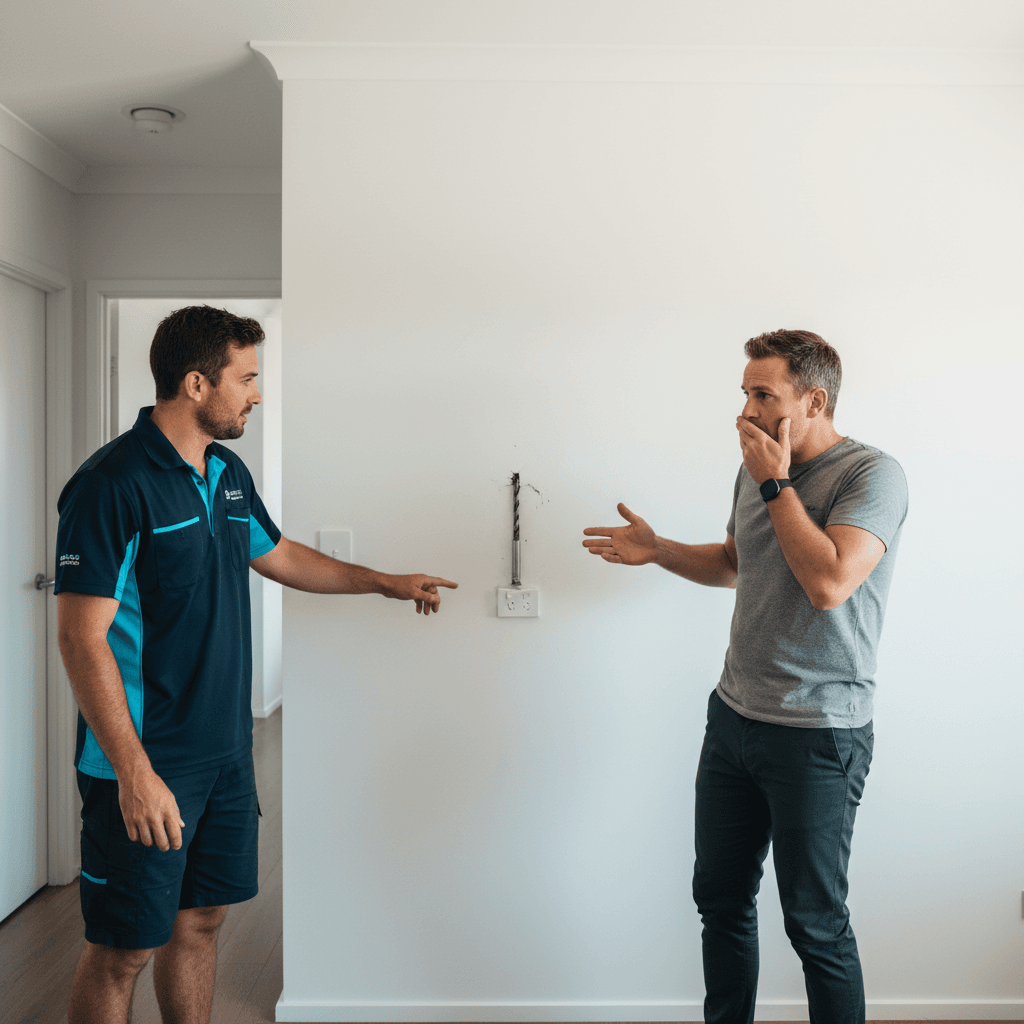
Drilling into a power cable is more common than most homeowners realise. I get one or two of these calls a year, and they almost always start the same way: someone was hanging a picture frame, or a tradie was fixing a towel rail, and the drill went in that bit too far. Then the breaker tripped, or there was a bang, or the drill just stopped.
If that's you right now, stay on this page for 90 seconds and read the sequence.
Right now: the exact sequence
- Do not pull the drill out. Put the drill down if it is still in your hand, but do not withdraw the bit from the wall. (See the next section for why.)
- Step away from the drill and the wall. Do not touch either.
- Do not touch the drill chuck, the cord, or the wall surface around the entry point.
- Go to the switchboard. Find the circuit that covers the area where you were drilling and switch it off. If you are not sure which circuit it is, switch off the main switch.
- Once the circuit is confirmed off, you may carefully remove the drill and step back.
- Ring a licensed electrician before doing anything else.
If anyone was shocked during the event: ring 000 first, then ring 0411 054 811.
Why you must not pull the drill out
The instinct is to back the drill bit out immediately. Resist it.
A drill bit that has penetrated a live cable may be the only thing physically holding the two cut conductors apart. The active and neutral conductors in a standard TPS (twin-and-earth) cable sit about 2-3mm apart in normal conditions. If the drill bit has gone through both, it may be bridging them in a way that, paradoxically, prevents a direct short circuit. Pull the bit out and you can change that geometry instantly, potentially causing an arc, a flash, or a continued current path to earth through you if you are touching the metallic drill body.
With the circuit off at the switchboard, the drill bit is inert metal in a wall. It is not going anywhere. Leave it for the sparky.
How to isolate at the switchboard safely
When you approach the switchboard after a drill incident, keep one hand in your pocket or behind your back. This is not superstition; it reduces the path any residual current would take through your chest if something goes wrong during isolation.
Find the circuit breaker or RCBO labelled for the room or area where you were drilling. Flip it to the off position. If you have no labels on your switchboard, or the labels are wrong (which happens in roughly a third of Brisbane homes older than 2000), switch the main switch off. The main switch is the largest switch in the board, usually labelled "Main" or "MS."
Once isolated, do a quick sanity check: try a light switch or a nearby powerpoint in the same room. If it is dead, the right circuit is off.
Do not attempt to remove the drill or inspect the cable until this isolation is confirmed.
If someone was shocked: what is legally required
If the drill incident caused an electric shock to any person, two things are legally required in QLD.
First, call 000 immediately if the person is unresponsive, has burns, chest pain, difficulty breathing, or lost consciousness. Even a brief loss of consciousness after a shock requires hospital assessment. Cardiac arrhythmias from electrical shock can be delayed.
Second, a serious electrical incident is a notifiable event under the QLD Electrical Safety Act 2002. The person in control of the workplace (in a home renovation, that is generally the homeowner or the principal contractor) has an obligation to preserve the scene and report the incident to the Electrical Safety Office. For a residential DIY situation, the practical advice is to ring the sparky first, who can guide you through the reporting requirements.
If the shock was a tingle with no loss of consciousness and no burns, a GP visit is worth it but 000 is not necessarily required. Still worth telling your electrician when they arrive.
How to avoid drilling into cables
The risk zones are predictable:
- Within 150mm above or below any powerpoint, light switch, or light fitting. Cables run vertically to and from these outlets and stay in that corridor inside the wall.
- Within 150mm horizontally from the edge of any door or window frame. Cables often route around openings and can run at unexpected heights.
- Directly behind any wall-mounted appliance such as a rangehood, oven, hot water unit or air-conditioner, because the supply cable runs down the wall behind the unit.
The practical tool is a cable scanner, a handheld device that detects live conductors through plasterboard. They are available at hardware stores for $50-$150. A decent one will pick up a live cable at 50-80mm depth. They are not infallible, they can miss cables at angles or in certain wall constructions, but they dramatically reduce the risk.
In a renovation context, the right time to know where all the cables are is before the walls go up. Ask the sparky to mark cable runs on the stud face before the plasterboard goes on, and photograph it before it closes up.
What the repair costs
A drilled cable is a straightforward repair for an electrician. The typical job:
- Isolate the circuit.
- Cut back the plasterboard in a small section around the damage.
- Splice or run a new cable tail, terminated into a junction box with appropriate fittings.
- Make good the wall (or confirm the homeowner will handle that part separately).
- Test the circuit and re-energise.
- Issue a Certificate of Test.
Typical cost: $280-$550 depending on the cable depth, the accessibility of the wall cavity, and whether a new length of cable is needed versus a short splice.
If the cable run needs to be replaced fully because the damage is close to a junction or the cable has VIR insulation (common in pre-1980 Brisbane homes), the cost increases but it is still a same-day job in most cases.
Ring 0411 054 811 if you've hit a cable. We cover Bulimba, Carindale, Camp Hill and surrounding suburbs same-day, and we won't leave the site until the circuit is tested and safe.
, John
I'm John, local Camp Hill sparky, fully licensed, fixed-price quotes, lifetime workmanship warranty. Ring me direct on 0411 054 811 or send a quick message.
Keep reading

What to do in an electrical emergency in SE QLD (the 60-second checklist)
Sparks, burning smell, total power loss, water hits the switchboard? Here's the exact 60-second checklist before you ring an emergency electrician.
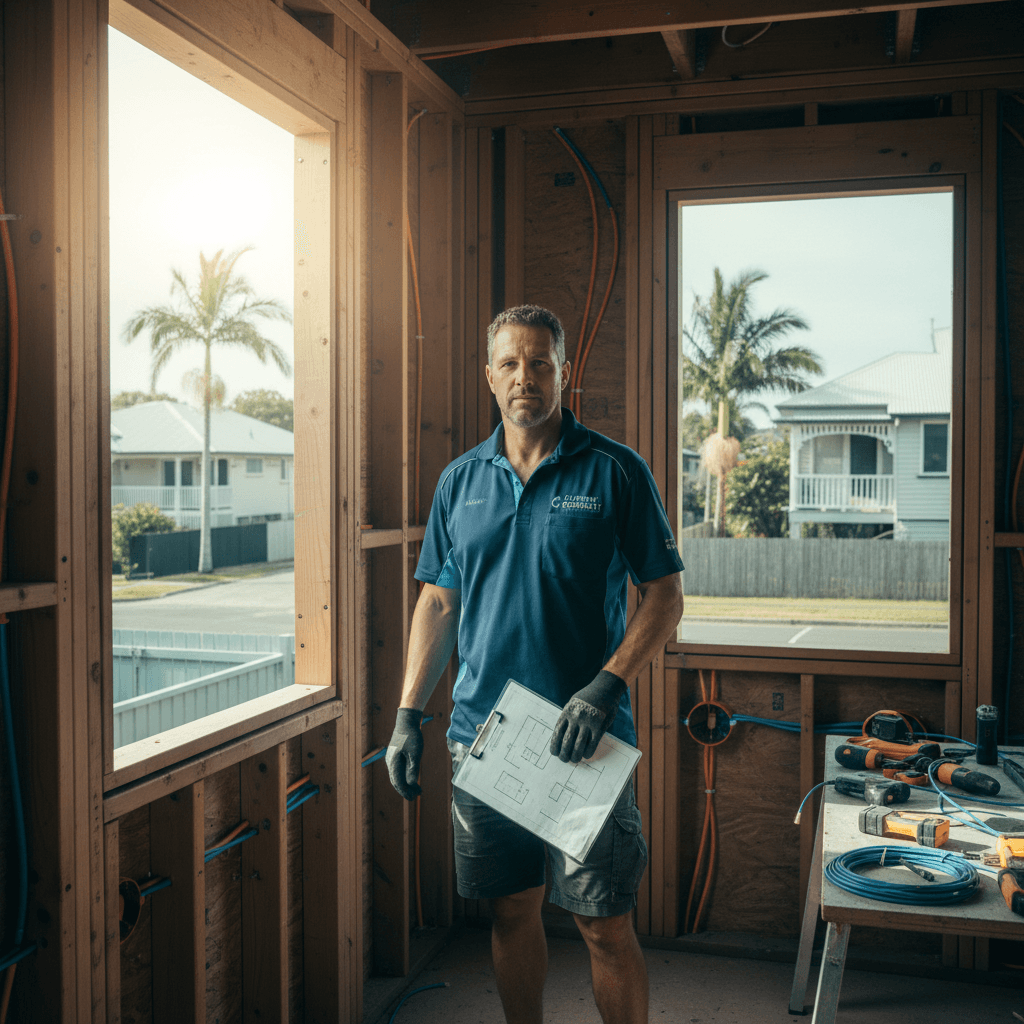
Renovation electrical checklist for Brisbane homes (the one your builder won't give you)
What to think about *before* the walls go back up. The 12-point electrical checklist for Brisbane renovations, from powerpoint locations to data cabling.